Organic growth partner for leading SaaS brands.



That’s what the “marketing” in “content marketing” means. Every piece of content must contribute to users, leads, revenue, and other critical business objectives.



Every team member is here to learn, become exceptional at their craft, and help our clients achieve results. Our mission is to transform our people into the best in the business.
Trusted by leading B2B marketing teams:




















Building and scaling organic growth engines since 2016.
Within our first year in business, our clients quickly realized that the quality of our content was far too good to create exclusively for other brands.
Not only that, but our expertise in growth marketing, content, and SEO over a decade of working with SaaS brands was being kept under wraps.




Blog posts

TL;DR: This list covers seven SaaS digital PR agencies: Grizzle, Position Digital, Crackle PR, Channel V Media, Rise at Seven, Siege Media, and Firecracker PR.
Marketing teams struggle to evaluate SaaS digital PR agencies because the category is poorly defined.
The agencies worth hiring in 2026 produce backlinks from high-authority publications, increase AI visibility, and build brand awareness.
Many agencies offering “digital PR” are still running a traditional playbook: press releases, impressions, and coverage that doesn’t compound.
This list will help you find the best agencies for your needs.
Why we built this list
Grizzle has run digital PR programs for SaaS companies since 2016. This means we’ve evaluated these agencies from the same vantage point as the marketing teams we pitch to.
While Grizzle appears on this list, we hold ourselves to the same selection criteria as every other entry.
Selection criteria:
- A significant SaaS client base (or B2B tech)
- Measurable results (mentions earned, AI visibility, named publication coverage)
- Ideal client transparency (state which growth stage they serve)
Who are the best SaaS digital PR agencies in 2026?
The agencies worth hiring in 2026 treat digital PR as a multi-channel motion.
While traditional PR measures impressions and clippings, digital PR measures organic growth, brand awareness, and revenue impact.
1. Grizzle
Grizzle builds content-led digital PR programs that generate authority and SEO/GEO impact.
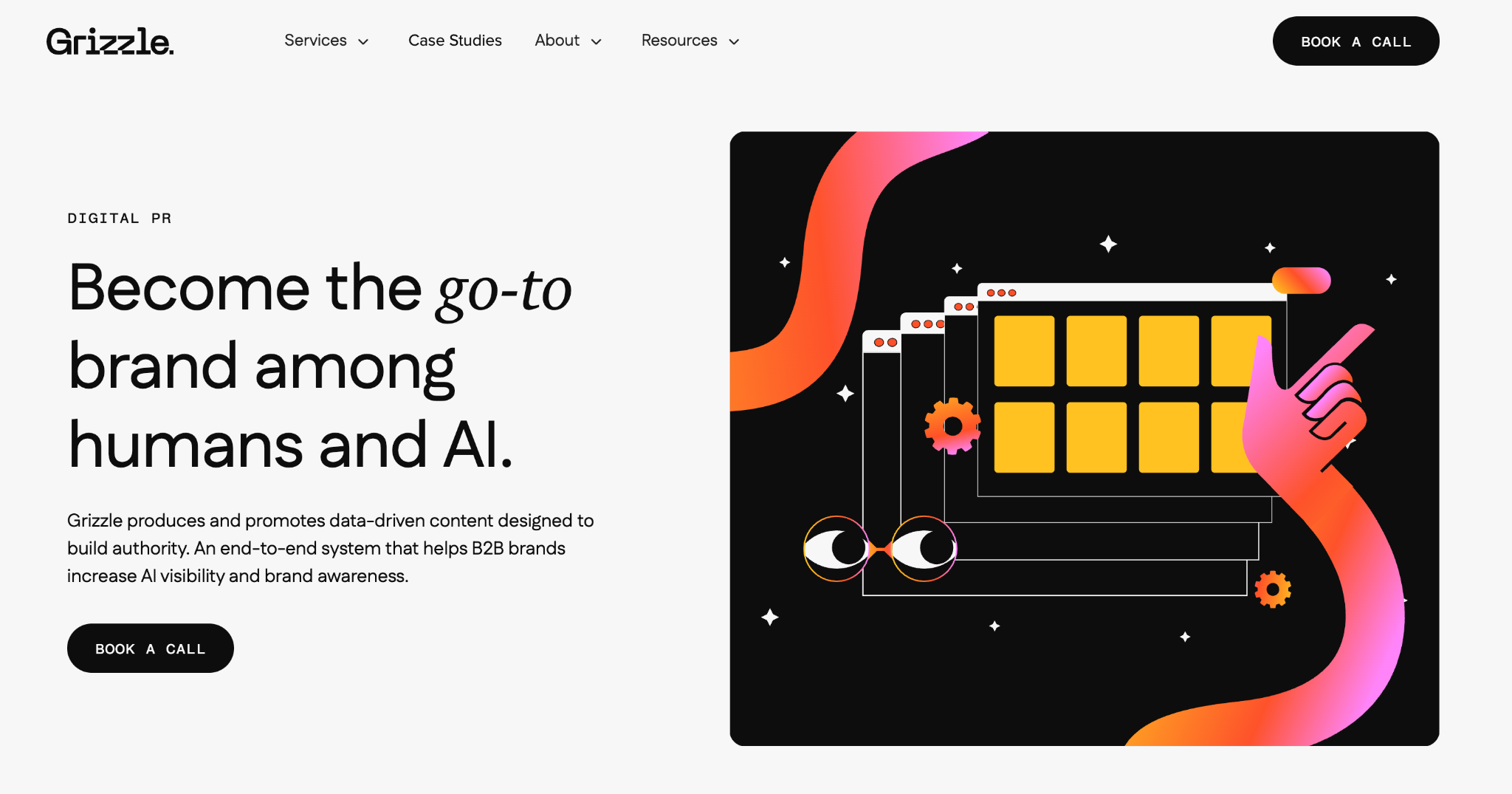
We create original research, data-driven studies, and thought leadership content that journalists are hungry for.
One original research project can generate mentions, fuel AI visibility, and serve as proof points across product marketing and sales enablement efforts.
For example, Pipedrive’s “State of Sales” report was produced end-to-end, distributed through Grizzle’s partner network, and pitched directly to journalists.
Our own SaaS YouTube Study was created through third-party data and in-depth analysis:

Both retainer programs and campaign sprints are available, giving growth teams flexibility based on budget and timeline.
Clients include Pipedrive, Semrush, Tipalti, and Tide Banking.
Case study: Grizzle helped Unmetric achieve a 441% increase in search traffic and earn editorial backlinks from tier 1 publications through targeted outreach, executive thought leadership, and editor relationships.
Grizzle’s key capabilities
- GEO and SEO alignment. Digital PR systems and campaigns are integrated into end-to-end organic growth systems.
- Original research and data studies. Industry surveys, benchmark data, and research reports built for journalist citation and AI visibility.
- Thought leadership and executive bylines. Guest placements and reactive content for founder and executive programs.
- Media and journalist outreach. Personalized pitches to journalists, editors, and content managers at non-competing SaaS brands.
- Partner network distribution. Tap into Grizzle’s network of editors, content creators, and media relationships to generate immediate traction.
- Digital PR subscriptions and campaign sprints. Always-on retainers or focused campaign sprints, depending on your goals.
- AI and GEO visibility. Mention generation in blogs, listicles, and publications that get cites in AI Overviews and LLMs.
What clients say about Grizzle
“Working with Grizzle is a breeze. They are pros who know exactly what they’re doing and have a modern organic growth playbook that gets results. Grizzle’s content quality is top-notch, and their work has directly contributed to our SEO and digital PR efforts.” — David Fallarme, Marketing Director, ReferralCandy
2. Position Digital
Position Digital is a digital PR agency for B2B SaaS that measures every placement against specific criteria.

Position Digital tracks two primary KPIs for every placement: PageRank value and LLM citation frequency.
A focus on search and brand awareness helps growth-stage SaaS companies achieve measurable outcomes, without the coordination overhead.
They’ve been known to generate results within 90 days. Every outcome is traceable to a specific campaign.
Clients include HR DataHub, Don’t Panic, ZERO 1, and Resource Guru.
Case study: Position Digital helped ZERO 1 achieve a 500% increase in organic traffic within three months through an integrated digital PR and SEO program.
Position Digital’s key capabilities
- Digital PR strategy. Campaign planning around AI visibility as a primary KPI alongside backlink and mention generation.
- Link acquisition. Targeted outreach to relevant publications with LLM citation tracking for every placement.
- AI and GEO visibility. Placement targeting based on publications that appear in AI Overviews and LLMs.
- Performance tracking. Reporting framework covering backlinks, DR lift, and AI citation frequency alongside traditional placement metrics.
What clients say about Position Digital
“In only 3 months, our organic traffic increased by 500% and we’re now number 1 in Google for our most important keywords.” — Finn MacCabe, Co-Founder, ZERO 1
3. Crackle PR
Crackle PR is a tech PR agency for VC-backed SaaS companies that builds GEO and LLM visibility.
Crackle PR tracks AI citation frequency as a primary PR output and targets publications that language models cite.
For VC-backed companies with Series C or IPO aspirations, institutional credibility and AI discoverability increasingly overlap. Getting into the publications that VCs and analysts read is crucial.
Their Creditsafe program has generated an estimated 10.8M views across one year of earned media, all attributed and verifiable.
Clients include ON24, Drift, Creditsafe, and Talkwalker.
Case study: Crackle PR helped Creditsafe achieve 1,940+ media mentions in one year and a 9x lift in share of voice through an earned media and GEO program.
Crackle PR’s key capabilities
- Earned media and press coverage. Targeted journalist outreach for VC-backed B2B tech companies from Series A through pre-IPO.
- GEO and AI visibility. Placement targeting in publications that AI models cite; citation frequency tracked as a KPI.
- Thought leadership and executive positioning. Bylines, podcast placements, and conference slots.
- VC and investor narrative. PR programs are built around fundraising milestones and the institutional credibility that supports them.
- Media monitoring and share-of-voice tracking. Ongoing measurement of brand mentions across the competitive landscape.
4. Channel V Media
Channel V Media is a tech PR agency that leads with editorial judgment.
Senior strategists advise clients on which stories are worth pitching before any outreach begins.
Channel V Media inverts the typical PR agency dynamic. Before pitching begins, they evaluate your story pipeline and recommend which narratives have a genuine shot at major outlets.
For a SaaS company stretched across multiple channels, pitching the wrong story can be expensive. to the right journalist. Clients consistently find value in Channel V’s ability to know what not to pitch, focusing on the campaigns most likely to land.
The agency has 15+ years of B2B tech experience across 200+ clients.
Clients include IBM, Bitrise, Bold Commerce, and GFT.
Case study: Channel V Media helped Meteomatics secure 70 media placements (including 25 federal-focused outlets) and 3 U.S. Federal Agency partnerships through targeted narrative pitching.
Channel V Media’s key capabilities
- Narrative development and messaging. Senior editorial advisors build the client’s story before any pitch is drafted.
- Media relations and news pitching. Targeted outreach across B2B tech, FinTech, and SaaS press developed over 15+ years.
- Thought leadership and bylines. Executive placement in trade and business press for founders and senior leaders.
- Market launch and product PR. PR programs for product releases, market entry, and category creation.
- Integrated content and PR. Research partnerships, podcast series, and proprietary studies produced alongside media outreach.
What clients say about Channel V Media
“They’ve helped us get famous through their unique blend of guile, tireless effort, and intelligence…our ROI is through the roof.” — Simon Kelly, COO, Story Worldwide
5. Rise at Seven
Rise at Seven is a search-first creative agency that builds digital PR campaigns with link acquisition and organic rankings as the primary outcomes.
Rise at Seven’s campaigns start with a search brief. Before content is created, the team maps keyword gaps and target publication authority.
Story development, brand research, and reactive campaigns are built to earn mentions and links from the publications that move search rankings.
Across 236 campaigns analyzed, Rise at Seven’s programs average 78% followed links from publications with a domain authority of 77.
While their customer base is predominantly B2C, they work with a select group of B2B clients.
Clients include SIXT, Magnet Trade, and Dojo
Case study: Rise at Seven’s B2B digital PR campaigns average 138% uplift in top search rankings and 81 links per campaign across 236 campaigns analyzed.
Rise at Seven’s key capabilities
- Search-first campaign strategy. Campaign briefs around keyword gaps and publications before any creative development begins.
- Digital PR creative and content. Data stories, reactive campaigns, brand research, and original studies designed to earn high-authority links.
- Link acquisition and domain authority. Targeted outreach to high-DA publications with a focus on followed links.
- Social amplification. Social content layered into PR campaigns to increase coverage.
- SEO integration. Organic ranking impact tracked per campaign.
What clients say about Rise at Seven
“They’ve delivered tangible organic results for JD Sports across Europe.” — Tim Giles, Head of SEO, JD Sports
6. Siege Media
Siege Media is a digital PR and content agency that earns 3,000+ links per month for clients through original data studies and industry research rather than outreach volume.
Siege Media’s link acquisition model is built around original research and data studies that earn placements in authoritative publications. Their total client traffic value exceeds $7.4M per month.
For growth-stage SaaS companies with high-volume link acquisitionneeds, every Siege asset serves two purposes: keyword rankings and backlinks from relevant publications.
Clients include Zapier, Zendesk, Asana, and Figma.
Case study: Siege Media helped Zapier achieve a $6.1M increase in organic traffic value and an 852% rise in traffic value.
Siege Media’s key capabilities
- Original research and data studies. Industry surveys, benchmarks, and proprietary data for citations and backlinks.
- Digital PR and link acquisition. Content-led placements in high-DA publications.
- Integrated organic growth. Dedicated SEO service combining content production, digital PR, and SEO strategy.
- Performance and traffic value tracking. Reporting on organic traffic value impact using Ahrefs traffic value methodology alongside keyword rankings.
What clients say about Siege Media
“They’re the absolute best in this business.” — Maddy Martin, VP of Marketing, Smith.ai
7. Firecracker PR
Firecracker PR is a B2B tech PR agency that promises to acquire 4 press articles in the first 30 days.

Firecracker’s 30-day, 4-article target is backed by the Ignites framework: a five-step process covering Promotion, Thought Leadership, Newsjacking, Source Filing, and Content Marketing.
For seed and Series A companies with investor timeline expectations, the upfront commitment removes a common objection to PR investment.
Most agencies hedge on timelines, but Firecracker commits to an outcome.
Clients include Fujitsu, Boeing, TP-LINK, and SimStudios.
Case study: Firecracker PR helped SimStudios achieve a 900% increase in web visits through a targeted B2B tech media campaign using the Ignites process.
Firecracker PR’s key capabilities
- Ignites five-step process. A defined PR framework that promises 4 press articles in your first 30 days.
- B2B tech media relations. Targeting tech, trade, and business press backed by 20+ years of journalist relationships.
- Product and launch PR. PR programs for product releases, company milestones, and market entry.
- Thought leadership and bylines. Executive placement in trade publications and business press.
- Analyst relations. Briefings and relationships with industry analysts — confirmed as part of the Ignites Thought Leadership step.
What clients say about Firecracker PR
“Firecracker PR landed us high profile articles in Entrepreneur.com, Business Insider and a radio interview within the first few months of our engagement. They exceeded my expectations of what a PR firm can deliver.” — William Hall, EVP of Corporate Learning at SimStudios
How do I choose the right SaaS digital PR agency?
Digital PR and traditional PR are different disciplines.
One measures impressions and clippings. The other measures backlinks, domain authority, and AI visibility.
Knowing which caters to your needs prevents you from entering a 6- to 12- month engagement with no measurable impact.
Before you reach out to anyone on this list, ask yourself these five questions:
Red flags to watch for when evaluating SaaS digital PR agencies
Four signals that an agency is unlikely to produce what a growth-stage SaaS company needs:
- No named clients in proof points. “We’ve helped B2B SaaS companies” without naming one is not a proof point. Any agency worth hiring can name a client and share results.
- They measure PR in impressions and reach. SaaS Digital PR should produce backlinks and coverage you can check in Ahrefs. If the agency leads with impressions, they’re producing traditional PR outcomes, rather than organic growth outcomes.
- Every major publication is on their target list. A credible digital PR agency knows which publications are relevant to your brand and ICP. A shopping list of Forbes, TechCrunch, and the Wall Street Journal with no context looks great, but won’t necessarily move the needle.
- The “guarantee” applies to activity, not outcomes. Promises around pitches sent or articles drafted measure inputs, not results. The only commitment worth paying for is tied to earned placements.
Frequently Asked Questions
What’s the difference between digital PR and traditional PR?
Traditional PR focuses on press releases, media mentions, and brand awareness measured in impressions.
Digital PR is built for search performance: placements in publications that build authority and appear in LLMs.
How much do SaaS digital PR agencies typically charge?
Digital PR retainers typically start between $3,000 to $5,000 per month, and can go as high as $15,000+ per month.
Fixed-scope campaigns (like Grizzle’s Digital PR Sprints) can start from $10,000.
Full-service programs combining content production, research, and media pitching at scale run higher. Sprints are an alternative for teams with a defined project and timeline rather than an ongoing need.
How long does it take to see results from digital PR?
First placements can arrive within 30 days. Backlinks show in domain authority metrics within 30–90 days of being earned and indexed.
Content-led programs—where original research is produced before any outreach begins—typically take 3 to 6 months to show compounding results.
AI visibility and citations improve as coverage accumulates in relevant publications, which operate on a longer timeline than traditional ranking signals.
How do I know if a digital PR agency is producing SEO value?
Branded searches, mentions, backlinks, and visibility scores in tools like Profound.
Check the agency’s target media list. Are they targeting relevant industry publications, or random and broad news sites?
Track whether your brand appears in ChatGPT, Perplexity, and Google AI Overviews for relevant category queries. Measure visibility and brand growth throughout the program.
Will digital PR help my SaaS brand appear in LLMs and AI Overviews?
Yes, if the placements are in the right publications. LLMs are trained on and cite high-authority web sources.
Being mentioned in those sources increases the probability that your brand appears in AI-generated answers. Not all media placements qualify.

TL;DR: This list covers seven SEO content writing services: Grizzle, Brafton, Verblio, Compose.ly, ClearVoice, Stellar Content, and Writing Studio. The right fit depends on your content maturity, volume needs, and how directly you need to attribute content to revenue.
Most buyers searching for SEO content writing services face the same challenge: finding a partner committed to business outcomes rather than word count or traffic.
The agencies worth hiring in 2026 write for humans, traditional search, and LLMs.
Their methodologies are adaptive in an environment where the playing field changes almost weekly.
This list will help you find two or three services that fit your growth stage and goals.
How we evaluated these SEO content writing services
Grizzle has spent over 10 years in the SEO content services space.
While we’ve included ourselves in this list, we know what separates agencies that deliver results from those that focus on vanity metrics.
Every entry meets at least two of the following three criteria:
- Credibility and a strong track record in the SEO content space
- Recommended by the SEO and marketing community
- Verified proof points like named clients, attributed testimonials, and case studies
Who are the best SEO content writing services in 2026?
The best agencies connect content to revenue, not just traffic.
60% of Google searches now result in zero clicks. LLMs have become an early stage of the customer journey.
This means SEO content services must adopt depth and expertise across all organic growth disciplines.
The services on this list provide content for humans, LLMs, and Google alike.
1. Grizzle
Grizzle is a content marketing agency that connects SEO content directly to revenue.

Every client gets access to expert writers, senior editors, and strategists. Engagements begin with audience research, SME interviews, and a deep dive into your product and features.
We build content for the full GEO and SEO ecosystem, delivering high-quality articles, case studies, YouTube videos, and product marketing content.
Cloudkicker, our proprietary AI-enabled content orchestration platform, enables high-volume and complex content programs to run smoothly.
For example, Tipalti scaled bottom-of-funnel content and YouTube content to achieve a 52% visibility score (according to Profound).

Clients include Pipedrive, Semrush, Tide Banking, and PandaDoc.
Case study: Grizzle helped Pipedrive grow global revenue by 39% and increase user sign-ups by 33% with an end-to-end SEO content and organic growth program.
Grizzle’s key capabilities
- SEO and GEO content production. Editorial content led by senior editors, content marketing specialists, and writers with industry expertise.
- Multi-channel coverage. Articles, product pages (industry, role, use cases, etc.), case studies, and more.
- Deep research and SME interviews. We become pseudo-experts and gain institutional knowledge on your product, industry, and ICP.
- Content & SEO strategy. Develop a roadmap for SEO success, from strategic direction to keyword research and distribution.
- Original research and data studies. Proprietary data that earns links, mentions, and AI citations.
- Content refreshing and optimization. Audit, update, and optimize your existing content to recover rankings and improve AI visibility.
- YouTube and video content. End-to-end production for video assets that build topical authority and capture attention.
What clients say about Grizzle
“Working with Grizzle has been a great experience. They’ve helped us scale up our SEO and content program, folding in seamlessly with our internal content operations. All while maintaining a high standard of content quality.” — Kyle Byers, Director of Growth Marketing, Semrush
2. Brafton
Brafton is a full-service content marketing agency that produces expert SEO content.

While many content writing services operate through networks, Brafton’s team includes both freelancers and in-house experts, providing a rare level of editorial consistency.
Brafton covers the full funnel: blog content, whitepapers, eBooks, email copy, landing pages, and social posts.
Many reviews rave about Brafton's consistency and reliability. Agencies that deliver on time in month one tend to maintain it in month six.
Clients include Quench USA, Career Profiles, Green Mountain Technology, and Dynaway.
Case study: Brafton helped Quench USA grow from 14,500 to nearly 80,000 organic sessions per month, with 36 of 64 new content pages ranking on Page 1.
Brafton’s key capabilities
- Topic ideation. Keyword research and content planning tied to commercial search intent.
- Blog and article production. In-house team handles research, writing, and editing.
- Whitepapers and eBooks. Long-form assets designed to capture and convert mid-funnel demand.
- Landing page and email copywriting. Full-funnel coverage beyond organic content; conversion copy produced alongside editorial.
- Social media content. Post creation and scheduling are all handled for you.
What clients say about Brafton
“They consistently deliver content, social media posts, and website updates on time.” — Nicole Mahon, Business Services Manager, CivicRisk Mutual
3. Verblio
Verblio is a scalable content production platform that builds US-based writer pools for agencies and content teams.
Each writer pool is matched to specific verticals, topic clusters, and content types. This white-glove service provides a decent advantage for agencies looking to scale their output.
Their writing team is US-based, and a proprietary API lets you integrate content ordering directly into existing workflows.
Verblio’s proprietary platform manages writers and briefs, helping in-house teams reduce overhead. It’s one of the few services in this category that agencies recommend consistently.
Clients include Dovetail, Growth Squad, Nextiny, and Seer.
Verblio’s key capabilities
- Custom writer pool. Dedicated writer teams built around your vertical, topic focus, or content format.
- Agency white-label production. Built for agencies running content programs for multiple clients simultaneously.
- API integrations. Programmatic content for teams with high volume and existing tech stacks.
- SEO content at scale. Keyword-targeted articles, product content, and long-form pieces at a throughput that outpaces in-house teams.
What clients say about Verblio
“That ability to scale immediately, to 2x, is what I could never do without having Verblio. I get results a lot faster than just a single blog writer pumping something out every month.” — Caitlin Burns, Content & SEO Lead, Dovetail
4. Compose.ly
Compose.ly is a managed content writing service that pairs brands with hand-selected talent.

Their flexible subscription model allows marketing teams to scale up or down as needed.
Every account gets access to a writer, editor, and SEO advisor. For example, they helped Mailchimp produce 41 long-form technical articles and generate first-page rankings within four months.
Inc. Magazine has listed Compose.ly among its fastest-growing companies since 2023.
Clients include Mailchimp, Everspring, Cleverly, and Dolby.io
Case study: Compose.ly cut Everspring’s content spend by 70% while tripling word output; organic traffic grew 114% alongside 638 new keyword positions.
Compose.ly’s key capabilities
- Managed content writing. Hand-selected writer, editor, and SEO advisor for every account.
- SEO strategy and keyword research. Search intent matching and keyword research are built into the production process.
- Blog article production. Their core offering allows you to scale from a handful of pieces per month to dozens.
- Technical and specialist content. Writers matched by industry background across various verticals.
What clients say about Compose.ly
“I’m impressed with Compose.ly’s process for cranking out good, consistent blog posts on time.” — Noemi Revah, Chief of Staff & Co-Founder, Cleverly
5. ClearVoice
ClearVoice is a managed content creation agency that produces blog posts, video scripts, and design through a single workflow.
Projects are managed by a single content manager. For marketing teams running omnichannel programs, this reduces operational headaches and coordination overhead.
Each project gets a dedicated specialist, ensuring every piece of content performs across your core channels.
Clients include Cabela’s, Intuit, Cisco, and Credit Karma.
Case study: ClearVoice helped Cabela’s achieve a 20% increase in organic search traffic in one year, with 11,000+ tracked keywords improving by 20.3% and multiple category pages reaching #1 on Google.
ClearVoice’s key capabilities
- Managed content creation. Full workflow from briefing to publication through a single account manager.
- Multi-format production. Blog posts, video scripts, whitepapers, infographics, and design under one roof.
- Vetted freelance talent marketplace. Specialist writers matched by industry and content type.
- Enterprise content programs. Built for high-volume multi-channel programs with rigorous approval workflows.
- SEO content strategy. Keyword planning, content calendars, and organic growth tracking alongside production.
What clients say about ClearVoice
“We genuinely could not have hit and exceeded our goals without the ClearVoice platform.” — Kristen Dahlin, Marketing Manager, Tailwind
6. Stellar Content
Stellar Content is a managed content platform built primarily for agencies.

Stellar’s BrandAlign technology enforces tone, structure, and quality standards across every writer and client account.
For agencies running white-label content for multiple clients, this directly addresses the “inconsistency-at-scale” problem. Content is usually delivered to a high standard.
Stellar’s production infrastructure handles brief management, writer management, and delivery.
Clients include Brainlabs, WealthSimple, Tinuiti, and CraftJack.
Case study: Stellar Content helped CraftJack achieve a 70% increase in organic traffic year-over-year through a managed content production program.
Stellar Content’s key capabilities
- BrandAlign technology. Proprietary system enforcing tone, structure, and quality standards.
- Agency white-label content production. Purpose-built for marketing agencies managing client content.
- Vetted writer network. 95%+ application rejection rate; writers selected for vertical expertise.
- SEO content at volume. Long-form articles, product content, and editorial produced at volume.
- Managed production workflow. Brief through to delivery handled by Stellar’s editorial team.
What clients say about Stellar Content
“We've had several different projects with them, and they were able to quickly assemble a team of writers and help us get our project off and running with very little lift on our end.” — Adam Goldkamp
7. Writing Studio
Writing Studio is a writing agency specialising in technical, health, and SaaS content.

Writing Studio serves verticals where inaccuracy has real consequences: healthcare, finance, and legal.
Writers are vetted based on domain expertise, ensuring content is accurate and authoritative.
Scaling content in technical industries is often an operational headache. Quality tends to decline as volume increases when the writer pool is shallow. Writing Studio’s matching model counters this.
Clients include Peak, Lab Effects LLC, Habit, and Cannabis Clinic.
Writing Studio’s key capabilities
- Technical content. Writers with domain expertise in software, developer tools, and complex B2B products.
- Health and YMYL content. Specialist writers for regulated and high-accuracy verticals where inaccuracy carries reputational or legal risk.
- SEO article production. Long-form, keyword-targeted content built to match search intent and earn organic rankings.
- Editor-led quality control. Every piece is reviewed before delivery.
- Flexible engagement model. Project-based and ongoing retainer options.
What clients say about Writing Studio
“My team was blown away by the quality articles they wrote. We can finally implement a content strategy that is sustainable. Would absolutely recommend working with them!” — Emma Bisogno, Director of Marketing, Lab Effects, LLC
How do I choose the right SEO content writing service for my company?
When reaching out to SEO content partners, ask clarifying questions to gauge their thinking before you see how they write.
Get clear on what you need and ask yourself these five questions:
Red flags to watch for when hiring an SEO content writing service
- Guaranteed rankings or traffic numbers. Forecasting shows you what’s possible based on your current state and industry. However, no legitimate service can guarantee outcomes.
- Deliverables tied only to word count. Knowing the deliverable you’re buying is crucial. But they should map to keywords and queries, buyer stages, and contribute to measurable goals.
- Case studies without named clients. “A Fortune 500 financial services company” is vague. Most agencies can at least offer named case studies during the sales process, but be wary of those who can’t.
- Reporting at the traffic level. If the monthly report is a GA4 session chart, then the agency doesn’t keep themselves accountable to revenue and other business objectives.
- High account manager turnover. Some agencies land an account, then rotate them through multiple AMs in the first year. Ask about team tenure before signing.
SEO content writing services FAQ
How long does it take to see results from an SEO content writing service?
Expect three to six months before you see consistent rankings and visibility. For competitive terms, meaningful organic traffic typically takes six to twelve months to generate.
Brand authority, publishing frequency, and keyword difficulty all affect the timeline. At Grizzle, we find that established brands gain traction faster than startups. AI visibility can grow faster than traditional rankings: a well-structured, expert-sourced piece can appear in LLM responses before it climbs the SERPs.
What’s the difference between an SEO content writing service and a content marketing agency?
A writing service executes against a brief: keyword, format, word count, and deadline. A content marketing agency sets the roadmap first, covering topic clusters, funnel mapping, and keyword prioritisation before execution.
Several services on this list do both; others are production-only.
How much do SEO content writing services cost?
Commodity services typically run $0.05–$0.15 per word. Managed services with editorial oversight range from $200–$600 per article. Full-service retainers with strategy built in start at $5,000–$20,000 per month.
Sub-$100 articles are possible, but at that price point, the economics require AI-first production or offshore writing without meaningful editorial review. Pricing usually signals quality.
How do I measure ROI from an SEO content writing service?
Full-funnel and self-attribution are non-negotiable. Most services provide traffic and session data, but you need to connect that to revenue.
For SaaS companies, pipeline attribution is key. Ask for the attribution methodology before signing the agreement.
Is AI-generated content effective for B2B SEO?
AI-assisted content, meaning AI drafts combined with human editing and SME input, can work for informational topics at low keyword difficulty.
However, it struggles with original research, technical depth, and GEO citation. Most audiences and algorithms alike reward demonstrable expertise. AI simulates it, SME input demonstrates it. For competitive B2B keywords, AI-first production carries real long-term risk.
The best AI content services use a blend of both, utilizing AI and humans where they work best.

Most SaaS companies treat YouTube as a dumping ground for product demos and webinars. The thought and care that go into email newsletters and executive LinkedIn programs rarely extend to YouTube channels.
But video has become a go-to format for product research. So, where does YouTube fit into the mix?
We analyzed 3,623 videos across 71 B2B SaaS YouTube channels to find out.
Paid promotion accounts for 91.4% of all long-form views
Many of the most-viewed B2B SaaS YouTube videos are promoted through YouTube Ads rather than generated organically.
They're easy to spot: extreme view counts paired with engagement rates an order of magnitude below organic baselines.

We applied a conservative filter to separate the two. Any video with ≥50,000 views AND an engagement rate below 0.0005 was flagged as “paid-promoted” and excluded from organic performance analysis.
The threshold catches videos where engagement is so disproportionate to their reach that paid distribution is the only realistic explanation.
For the rest of this study, every claim about "what works" is computed against the organic distribution only.
YouTube videos appear in AIOs for 74.9% of SaaS keywords and queries
Of the 873 searches we ran, 95.4% triggered an AI Overview (AIO).
74.9% (624 of 873) cited a YouTube channel, and only 4.2% cited a tracked SaaS channel.
Across 542 BOFU keywords (e.g. "best CRM software," "klaviyo alternatives," and "hubspot vs salesforce"), YouTube appeared in the AIOs 75.1% of the time.
Of those BOFU terms, our tracked brands only appeared 3% of the time.
Finally, of 138 branded keywords in our dataset (e.g. "hubspot vs salesforce", "klaviyo alternatives", "monday.com vs asana"), YouTube was cited in the AIOs for 120 of them (87%).
However, 0.7% of those citations came from any of the 71 brand channels we tracked.
Independent creators dominate the rest. The top 10 cited channels in our dataset are HelperMan, Consumer Research Studios, Merchant Maverick, and 6 other independent creators.
61 of the 71 brand channels we studied earned zero AIO citations across the entire 873-query study. Among the 10 brands that did appear, 9 earned five or fewer citations.
Only ClickUp earned more than nine citations across more than four keywords:

This doesn’t mean that AIOs aren’t prioritizing brand channels. One likely explanation is that our tracked brands are producing less content aligned with buyer queries and prompts. We see this is the case with ClickUp (and through our own experiences with clients at Grizzle).

Top 10% of videos drive 42.2% of channel views
The top 5% of videos account for a median of 25.1% of total channel views. The top 10% accounts for 42.2%.

This isn't a SaaS quirk; it's how YouTube content is generally distributed.
A handful of videos in any given channel earn most of the attention. The rest accumulate views slowly or not at all.
This is true whether the channel publishes 30 videos a year or 300.
It would be easy to conclude that we should produce fewer, higher-quality videos. However, higher publishing velocity is correlated with breakout formats.
Most channels publish their lowest-performing videos on a set cadence (e.g., webinars, feature releases).
Video formats that generate views are rarely replicated, even when they outperform newer videos.
These findings share a best practice that most B2B SaaS teams skip: figure out which of your videos drive views, study what they have in common, and standardize them.
Winning formats aren't predictable. You need enough at-bats to find them. The top-performing channels showed a pattern consistent with analyzing top performers and doubling down on winning formats.
YouTube title patterns that earn views (and the ones that hurt)
We analyzed every word, structure, and convention across our 1,954 organic long-form videos and measured each against the 218-view organic baseline.
Eight patterns are associated with performance meaningfully above baseline.
Titles that perform above baseline
Dollar amounts in the title earn 10x the baseline. Titles like "How I Built a $5M SaaS in 18 Months" or "We Spent $50K on This Campaign and Here's What We Learned" pull the strongest median views in the entire dataset.
The number itself functions as a specificity signal, telling viewers there's a concrete outcome on the other side of the click.
First-person voice earns nearly 5x. Titles like "I Tested Every CRM" and "My Worst Hire Cost Me $200K" outperform the baseline by 4.90x.
This is the same first-person voice that dominates the AIOs (8.4% of cited videos use it, vs 2.1% in branded B2B channels). "I," "my," or "I've" signal real-world perspectives.
"Best" in the title earns 3.24x. Listicles and category roundups continue to perform exactly as you'd expect from the cited-universe data.
Titles like “The 5 Best Project Management Tools" and "Best CRM for Small Business" win both attention and AIO citations for BOFU terms.
Brackets and parentheses earn 2.98x. Titles with [2026 Update] or (Step-by-Step) or [Free Template] clarify what the viewer is getting before they click.
The bracket is, functionally, a UI element that visually separates a tangible promise from the topic itself.
The other winners all share a common structural property: they tell the viewer specifically what they'll get by watching.
Underperforming title patterns
The underperformers are remarkably consistent and common in B2B SaaS YouTube channels.
Dash-separated titles earn 0.44x baseline. "Brand Name - Product Demo - Q3 Webinar" is the canonical format here.
The dashes signal cataloging, implying that the video was uploaded for internal organization, rather than to add value.
Titles with the word "podcast" earn 0.63x. This is one of the most counterintuitive findings in the dataset. Branded B2B podcasts on YouTube consistently underperform the channel's other content.
This doesn’t mean that podcasts aren’t effective; they’re just usually packaged in a way that doesn’t signal the value a user will get from watching or listening.
Titles 70+ characters earn 0.75x. Long titles are truncated. They're often the result of a marketing team trying to keyword stuff rather than communicate value. Both are important.
The remaining underperformers share the same structural property: they describe what the video is rather than promising what the viewer will get.
Most B2B YouTube titles include underperforming patterns
38% of SaaS video titles use only underperforming title patterns. Only 18% use winning patterns.
Underperforming title patterns show a median of 160 views; those using only winning patterns show 734.

Combining winning and underperforming patterns showed no meaningful lift over using neither. 16% of videos that contain both earn a median of 212 views; essentially the same as titles using neither.
Adding "Best" to a title that still leads with a brand name doesn't lead to any meaningful lift.
An important note: some of these conventions show up in the AIOs at meaningful rates. A title like "HubSpot - Product Demo" performs worse than "ClickUp vs Notion - Which Is Better?"
63% of B2B SaaS thumbnails use the worst-performing aesthetic style
Three aesthetic thumbnail styles dominate the dataset:
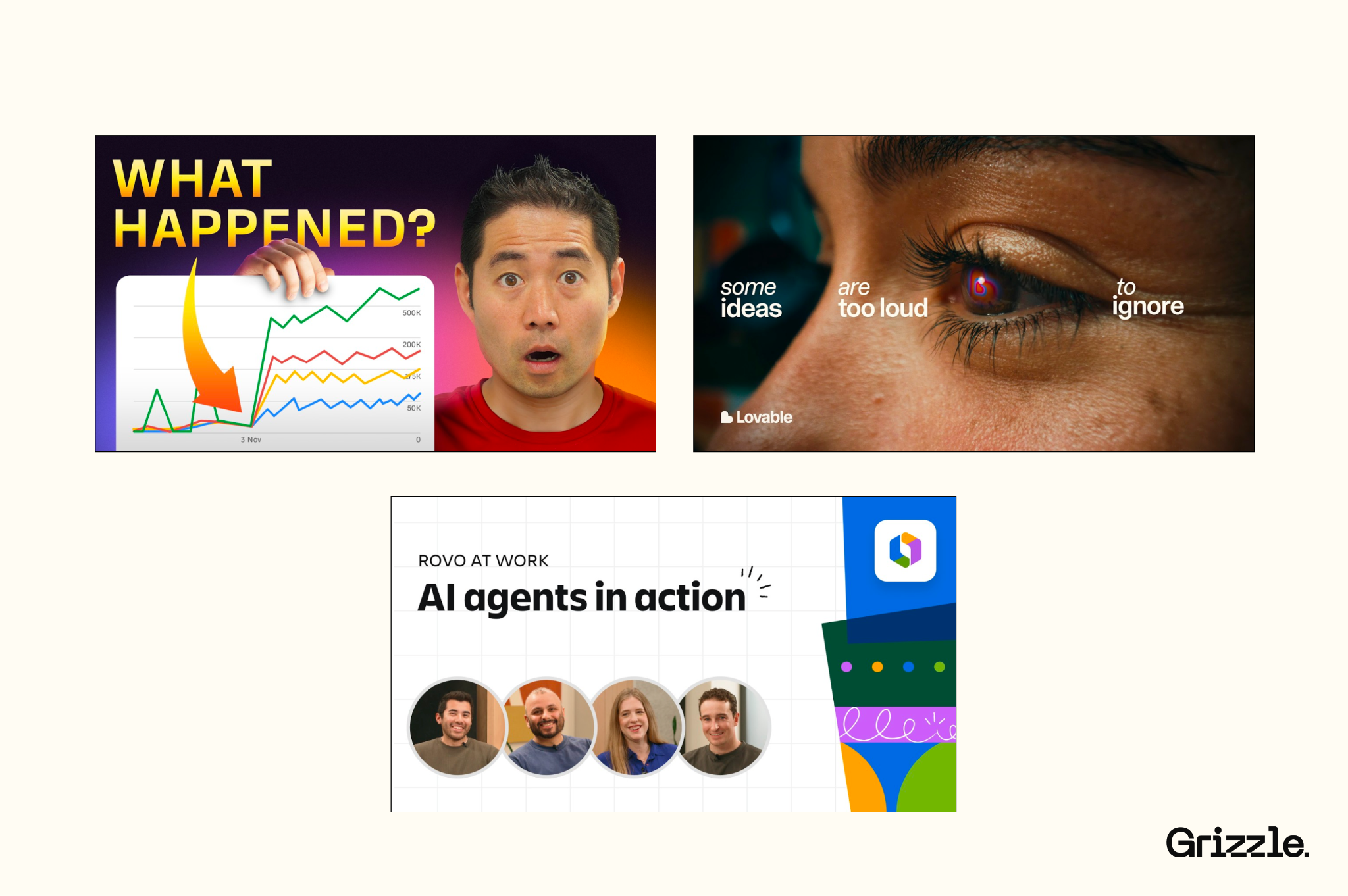
- Corporate/clean. Neutral colors, restrained typography, plenty of white space. The default B2B SaaS look.
- Editorial/magazine. More design-forward, often with overlaid pull quotes or magazine-style layout.
- Creator-style. Bright contrast colors, expressive faces, bold sans-serif text, deliberate visual chaos.

Creator-style thumbnails make up just 16% of the dataset but earn a median of 582 views (2.67x above the organic baseline).
Corporate-style thumbnails make up 63% of the dataset and earn 171 views, well below baseline.
The most common choice in B2B SaaS is also the lowest-performing. The highest performing thumbnails tend to look the least polished and corporate.
Visual complexity is counterintuitive
A common design assumption is that clean, minimal thumbnails beat busy, cluttered ones. Our data suggests the opposite:
- Clean/minimal (27% of dataset): median 176 views (0.81x)
- Moderate (62%): median 204 views (0.94x)
- Busy/cluttered (11%): median 475 views (2.18x)
YouTube thumbnails compete in a feed against creator content. Visual density suggests there's something worth paying attention to and stops the scroll.
Thumbnail patterns that work
Beyond aesthetic style and complexity, three simple binary features predict performance:
- Bright contrasting colors (64% of dataset): 1.93x lift when present
- Face + text + UI elements like icons, annotations, and graphs (rare structural combo, 7%): 2.04x lift
- Face + text overlay (without UI elements) is the most common combo (43%), but only earns a 1.14x lift
The face + text + product UI element combination is the rarest of the three structural configurations, yet it’s the highest-performing:

Most B2B SaaS thumbnails either show a person OR UI elements OR text overlay. The combination earns 2x the baseline.
Owner.com's thumbnails are almost all creator-style (the highest-performing category, scoring 2.94 on the 1-3 aesthetic scale against a 1.53 organic mean). 100% feature a face, 78% use bright contrast color, and 50% include numbers in the visual (against a 21% baseline).
Their long-form videos earn a median of 2,413 views—ranking #9 of 69 channels by median organic views—with zero paid promotion.
Thumbnails aren’t a magic bullet
Thumbnail patterns aren’t deterministic.
One SaaS brand in our dataset scores high on every winning thumbnail dimension: bright contrast color, prominent face presence, high aesthetic style.
However, its median view count is 62, well below the baseline of 218 (0.28x).
Thumbnail patterns may support CTR, but they aren’t sufficient. Topic selection and channel positioning still matter.
Shorts up to 15 seconds long earn 2.72x more views
We analyzed 1,533 organic Shorts across the same 71 channels. The organic baseline for Shorts is 445 views; roughly double the long-form baseline.
Duration is the dominant lever
Duration is the strongest predictor of Shorts performance in our dataset.

Shorts under 15 seconds earn a median 1,210 views (2.72x the baseline). They're the highest-performing duration bucket by a wide margin.
They're also the rarest among our dataset: only 7% of SaaS Shorts fall within this duration.
The modal duration in is 45-60 seconds, with 35% of the dataset falling within this range. These earn a median 233 views (0.52x the baseline).
The most common Shorts are the longest and lowest-performing. 70% of B2B SaaS Shorts are 31 seconds or longer.
Title patterns flip from long-form
Listicle and tutorial framing wins in long-form. In Shorts, the patterns that earn the most views are curiosity hooks:
"Best," year markers, or "X vs Y" comparisons don’t make the list. The patterns that dominate the long-form cited universe are absent from the Shorts winners.
Among our dataset, Lovable is pushing these patterns the hardest. Their 29 organic Shorts earn a median of 187,214 views, the highest in the study.
Their top Short, "How Much Coffee Do Humans Drink?", has earned over 41 million organic views. The titles consistently use the personal "I/my" voice ("I created their dream app", "I Build His Dream Website In 2 min"), curiosity hooks, and questions.
The lowest-performing Shorts title patterns include:
Shorts are consumed in a different context. Titles and descriptions have to stop the scroll, not promise a complete answer.
Description length matters
Most B2B SaaS teams treat Short descriptions as an afterthought. The data suggests length is crucial for performance:
- No description (16% of Shorts): 0.68x baseline
- Short, 1-10 words: 1.74x baseline (the highest-performing length)
- Medium, 11-50 words: 1.09x baseline
- Long, 50+ words: 0.86x baseline
Having a description present outperforms no description by more than 2.5x. 50+ word descriptions underperform the baseline. The optimal description is a single sentence of no more than 10 words.
Format split per channel
Of the 56 channels in our dataset with at least 10 long-form videos and 10 Shorts, the median Shorts:long-form ratio is 1.48x
The typical channel earns 48% more views per Short than per long-form video.
But the distribution is bimodal:
- 17 channels: Shorts earn more than 2x their long-form
- 14 channels: long-form earns more than Shorts
- The remaining 25 are roughly balanced
The channels with a Shorts-dominant strategy have figured out how to make them work. Others are clearly long-form-dominant. Both can work, depending on what outcome you’re prioritizing.
Most SaaS YouTube programs treat them as variations of the same message. The data says they're not. Shorts and long-form videos are different formats with different rules.
The library effect: old videos still earn views
We grouped all 1,954 organic long-form videos into age cohorts based on how long they'd been published as of our pull date, then measured median view velocity (views per day, lifetime) across each cohort:
The decay-then-rebound pattern
Views per day drop sharply through year one—from 8.60/day to 0.68/day—which is what you'd expect as initial attention wears off.
In the 1-2 year cohort, median velocity rebounds to 1.70/day, more than double the 180-365 day cohort.
33% of videos older than 5 years still earn at least 1 view per day. However, this isn’t sustained beyond the 2- to 3-year cohort, which drops to just 11%.
This is consistent with videos earning search and AIO visibility long after publication. By the time a video is a year old, it's either found a steady source of organic discovery or views drop close to zero.
What we can't claim from this data
A single snapshot can't prove that old videos are currently earning ongoing traffic. We have cumulative view counts as of our pull date, but no time-series data.
The rebound in the 1-2 year cohort might reflect ongoing discovery, or it might reflect a small set of unusually strong videos that earned most of their views in their first year and held.
What the data does suggest, even at this confidence level, is that SaaS YouTube libraries are an asset class that most teams systematically underweight.
What this means for SaaS YouTube programs
This study identifies patterns that indicate traditional “creator” YouTube principles are just as effective for SaaS brands.
Channels that break out of that pattern share three traits:
- They make an explicit strategic choice. Are you playing for AI Overview placement, niche category dominance, or top-of-funnel reach? These require different content, different cadences, different production capabilities.
- They study their hits. The top 10% of videos in any channel account for ~42% of its views. The teams that analyze top-performers, identify what makes them effective, and double down on them start to compound.
- They work with the algorithms, not against them. Long-form titles that promise viewer benefit, Shorts produced for the format on its own terms, thumbnails designed to win attention in a feed. Each pattern leans into what each platform mechanic rewards. Stack enough of them, and the algorithm starts working for you, not against you.
Methodology
We pulled video and channel metadata for 71 leading B2B SaaS YouTube channels via the YouTube Data API, featuring both established brands (e.g., HubSpot, Atlassian) and newer entrants (Granola, Lovable).
- The analysis covers 3,623 videos total (1,976 long-form and 1,647 Shorts) across January 2007 through May 2026. For each video, we captured title, description, duration, view count, like count, comment count, published date, engagement rate, and format.
- The pull was capped at the most recent ~30 long-form and ~30 Shorts per channel. For marketing teams asking what's working right now, recent output is a more reliable signal than a decade of uploads. Channels with large back-catalogues are represented by their most recent work.
- We analyzed 873 keywords to capture every YouTube video cited in AIOs, video carousels, and other SERP features. Keywords were split across informational, non-branded bottom-of-funnel (BOFU) queries (e.g. "best CRM software"), and branded terms and comparison queries (e.g. "hubspot vs salesforce").
- For thumbnail analysis, we coded 1,976 thumbnails via the Anthropic API, against a structured taxonomy of binary features (face, text, product UI, etc.) and stylistic dimensions (aesthetic style, complexity, contrast, emotional intensity).
The patterns identified in this study are correlational. We can't confirm that any individual pattern causes higher or lower performance, but the associations are consistent enough across the dataset to be directionally useful.
Trusted by B2B marketing leaders:










Get started with Grizzle.