Playbooks and guides by Grizzle


TL;DR: This list covers seven SaaS digital PR agencies: Grizzle, Position Digital, Crackle PR, Channel V Media, Rise at Seven, Siege Media, and Firecracker PR.
Marketing teams struggle to evaluate SaaS digital PR agencies because the category is poorly defined.
The agencies worth hiring in 2026 produce backlinks from high-authority publications, increase AI visibility, and build brand awareness.
Many agencies offering “digital PR” are still running a traditional playbook: press releases, impressions, and coverage that doesn’t compound.
This list will help you find the best agencies for your needs.
Why we built this list
Grizzle has run digital PR programs for SaaS companies since 2016. This means we’ve evaluated these agencies from the same vantage point as the marketing teams we pitch to.
While Grizzle appears on this list, we hold ourselves to the same selection criteria as every other entry.
Selection criteria:
- A significant SaaS client base (or B2B tech)
- Measurable results (mentions earned, AI visibility, named publication coverage)
- Ideal client transparency (state which growth stage they serve)
Who are the best SaaS digital PR agencies in 2026?
The agencies worth hiring in 2026 treat digital PR as a multi-channel motion.
While traditional PR measures impressions and clippings, digital PR measures organic growth, brand awareness, and revenue impact.
1. Grizzle
Grizzle builds content-led digital PR programs that generate authority and SEO/GEO impact.
We create original research, data-driven studies, and thought leadership content that journalists are hungry for.
One original research project can generate mentions, fuel AI visibility, and serve as proof points across product marketing and sales enablement efforts.
For example, Pipedrive’s “State of Sales” report was produced end-to-end, distributed through Grizzle’s partner network, and pitched directly to journalists.
Our own SaaS YouTube Study was created through third-party data and in-depth analysis:

Both retainer programs and campaign sprints are available, giving growth teams flexibility based on budget and timeline.
Clients include Pipedrive, Semrush, Tipalti, and Tide Banking.
Case study: Grizzle helped Unmetric achieve a 441% increase in search traffic and earn editorial backlinks from tier 1 publications through targeted outreach, executive thought leadership, and editor relationships.
Grizzle’s key capabilities
- GEO and SEO alignment. Digital PR systems and campaigns are integrated into end-to-end organic growth systems.
- Original research and data studies. Industry surveys, benchmark data, and research reports built for journalist citation and AI visibility.
- Thought leadership and executive bylines. Guest placements and reactive content for founder and executive programs.
- Media and journalist outreach. Personalized pitches to journalists, editors, and content managers at non-competing SaaS brands.
- Partner network distribution. Tap into Grizzle’s network of editors, content creators, and media relationships to generate immediate traction.
- Digital PR subscriptions and campaign sprints. Always-on retainers or focused campaign sprints, depending on your goals.
- AI and GEO visibility. Mention generation in blogs, listicles, and publications that get cites in AI Overviews and LLMs.
What clients say about Grizzle
“Working with Grizzle is a breeze. They are pros who know exactly what they’re doing and have a modern organic growth playbook that gets results. Grizzle’s content quality is top-notch, and their work has directly contributed to our SEO and digital PR efforts.” — David Fallarme, Marketing Director, ReferralCandy
2. Position Digital
Position Digital is a digital PR agency for B2B SaaS that measures every placement against specific criteria.

Position Digital tracks two primary KPIs for every placement: PageRank value and LLM citation frequency.
A focus on search and brand awareness helps growth-stage SaaS companies achieve measurable outcomes, without the coordination overhead.
They’ve been known to generate results within 90 days. Every outcome is traceable to a specific campaign.
Clients include HR DataHub, Don’t Panic, ZERO 1, and Resource Guru.
Case study: Position Digital helped ZERO 1 achieve a 500% increase in organic traffic within three months through an integrated digital PR and SEO program.
Position Digital’s key capabilities
- Digital PR strategy. Campaign planning around AI visibility as a primary KPI alongside backlink and mention generation.
- Link acquisition. Targeted outreach to relevant publications with LLM citation tracking for every placement.
- AI and GEO visibility. Placement targeting based on publications that appear in AI Overviews and LLMs.
- Performance tracking. Reporting framework covering backlinks, DR lift, and AI citation frequency alongside traditional placement metrics.
What clients say about Position Digital
“In only 3 months, our organic traffic increased by 500% and we’re now number 1 in Google for our most important keywords.” — Finn MacCabe, Co-Founder, ZERO 1
3. Crackle PR
Crackle PR is a tech PR agency for VC-backed SaaS companies that builds GEO and LLM visibility.
Crackle PR tracks AI citation frequency as a primary PR output and targets publications that language models cite.
For VC-backed companies with Series C or IPO aspirations, institutional credibility and AI discoverability increasingly overlap. Getting into the publications that VCs and analysts read is crucial.
Their Creditsafe program has generated an estimated 10.8M views across one year of earned media, all attributed and verifiable.
Clients include ON24, Drift, Creditsafe, and Talkwalker.
Case study: Crackle PR helped Creditsafe achieve 1,940+ media mentions in one year and a 9x lift in share of voice through an earned media and GEO program.
Crackle PR’s key capabilities
- Earned media and press coverage. Targeted journalist outreach for VC-backed B2B tech companies from Series A through pre-IPO.
- GEO and AI visibility. Placement targeting in publications that AI models cite; citation frequency tracked as a KPI.
- Thought leadership and executive positioning. Bylines, podcast placements, and conference slots.
- VC and investor narrative. PR programs are built around fundraising milestones and the institutional credibility that supports them.
- Media monitoring and share-of-voice tracking. Ongoing measurement of brand mentions across the competitive landscape.
4. Channel V Media
Channel V Media is a tech PR agency that leads with editorial judgment.
Senior strategists advise clients on which stories are worth pitching before any outreach begins.
Channel V Media inverts the typical PR agency dynamic. Before pitching begins, they evaluate your story pipeline and recommend which narratives have a genuine shot at major outlets.
For a SaaS company stretched across multiple channels, pitching the wrong story can be expensive. to the right journalist. Clients consistently find value in Channel V’s ability to know what not to pitch, focusing on the campaigns most likely to land.
The agency has 15+ years of B2B tech experience across 200+ clients.
Clients include IBM, Bitrise, Bold Commerce, and GFT.
Case study: Channel V Media helped Meteomatics secure 70 media placements (including 25 federal-focused outlets) and 3 U.S. Federal Agency partnerships through targeted narrative pitching.
Channel V Media’s key capabilities
- Narrative development and messaging. Senior editorial advisors build the client’s story before any pitch is drafted.
- Media relations and news pitching. Targeted outreach across B2B tech, FinTech, and SaaS press developed over 15+ years.
- Thought leadership and bylines. Executive placement in trade and business press for founders and senior leaders.
- Market launch and product PR. PR programs for product releases, market entry, and category creation.
- Integrated content and PR. Research partnerships, podcast series, and proprietary studies produced alongside media outreach.
What clients say about Channel V Media
“They’ve helped us get famous through their unique blend of guile, tireless effort, and intelligence…our ROI is through the roof.” — Simon Kelly, COO, Story Worldwide
5. Rise at Seven
Rise at Seven is a search-first creative agency that builds digital PR campaigns with link acquisition and organic rankings as the primary outcomes.
Rise at Seven’s campaigns start with a search brief. Before content is created, the team maps keyword gaps and target publication authority.
Story development, brand research, and reactive campaigns are built to earn mentions and links from the publications that move search rankings.
Across 236 campaigns analyzed, Rise at Seven’s programs average 78% followed links from publications with a domain authority of 77.
While their customer base is predominantly B2C, they work with a select group of B2B clients.
Clients include SIXT, Magnet Trade, and Dojo
Case study: Rise at Seven’s B2B digital PR campaigns average 138% uplift in top search rankings and 81 links per campaign across 236 campaigns analyzed.
Rise at Seven’s key capabilities
- Search-first campaign strategy. Campaign briefs around keyword gaps and publications before any creative development begins.
- Digital PR creative and content. Data stories, reactive campaigns, brand research, and original studies designed to earn high-authority links.
- Link acquisition and domain authority. Targeted outreach to high-DA publications with a focus on followed links.
- Social amplification. Social content layered into PR campaigns to increase coverage.
- SEO integration. Organic ranking impact tracked per campaign.
What clients say about Rise at Seven
“They’ve delivered tangible organic results for JD Sports across Europe.” — Tim Giles, Head of SEO, JD Sports
6. Siege Media
Siege Media is a digital PR and content agency that earns 3,000+ links per month for clients through original data studies and industry research rather than outreach volume.
Siege Media’s link acquisition model is built around original research and data studies that earn placements in authoritative publications. Their total client traffic value exceeds $7.4M per month.
For growth-stage SaaS companies with high-volume link acquisitionneeds, every Siege asset serves two purposes: keyword rankings and backlinks from relevant publications.
Clients include Zapier, Zendesk, Asana, and Figma.
Case study: Siege Media helped Zapier achieve a $6.1M increase in organic traffic value and an 852% rise in traffic value.
Siege Media’s key capabilities
- Original research and data studies. Industry surveys, benchmarks, and proprietary data for citations and backlinks.
- Digital PR and link acquisition. Content-led placements in high-DA publications.
- Integrated organic growth. Dedicated SEO service combining content production, digital PR, and SEO strategy.
- Performance and traffic value tracking. Reporting on organic traffic value impact using Ahrefs traffic value methodology alongside keyword rankings.
What clients say about Siege Media
“They’re the absolute best in this business.” — Maddy Martin, VP of Marketing, Smith.ai
7. Firecracker PR
Firecracker PR is a B2B tech PR agency that promises to acquire 4 press articles in the first 30 days.

Firecracker’s 30-day, 4-article target is backed by the Ignites framework: a five-step process covering Promotion, Thought Leadership, Newsjacking, Source Filing, and Content Marketing.
For seed and Series A companies with investor timeline expectations, the upfront commitment removes a common objection to PR investment.
Most agencies hedge on timelines, but Firecracker commits to an outcome.
Clients include Fujitsu, Boeing, TP-LINK, and SimStudios.
Case study: Firecracker PR helped SimStudios achieve a 900% increase in web visits through a targeted B2B tech media campaign using the Ignites process.
Firecracker PR’s key capabilities
- Ignites five-step process. A defined PR framework that promises 4 press articles in your first 30 days.
- B2B tech media relations. Targeting tech, trade, and business press backed by 20+ years of journalist relationships.
- Product and launch PR. PR programs for product releases, company milestones, and market entry.
- Thought leadership and bylines. Executive placement in trade publications and business press.
- Analyst relations. Briefings and relationships with industry analysts — confirmed as part of the Ignites Thought Leadership step.
What clients say about Firecracker PR
“Firecracker PR landed us high profile articles in Entrepreneur.com, Business Insider and a radio interview within the first few months of our engagement. They exceeded my expectations of what a PR firm can deliver.” — William Hall, EVP of Corporate Learning at SimStudios
How do I choose the right SaaS digital PR agency?
Digital PR and traditional PR are different disciplines.
One measures impressions and clippings. The other measures backlinks, domain authority, and AI visibility.
Knowing which caters to your needs prevents you from entering a 6- to 12- month engagement with no measurable impact.
Before you reach out to anyone on this list, ask yourself these five questions:
Red flags to watch for when evaluating SaaS digital PR agencies
Four signals that an agency is unlikely to produce what a growth-stage SaaS company needs:
- No named clients in proof points. “We’ve helped B2B SaaS companies” without naming one is not a proof point. Any agency worth hiring can name a client and share results.
- They measure PR in impressions and reach. SaaS Digital PR should produce backlinks and coverage you can check in Ahrefs. If the agency leads with impressions, they’re producing traditional PR outcomes, rather than organic growth outcomes.
- Every major publication is on their target list. A credible digital PR agency knows which publications are relevant to your brand and ICP. A shopping list of Forbes, TechCrunch, and the Wall Street Journal with no context looks great, but won’t necessarily move the needle.
- The “guarantee” applies to activity, not outcomes. Promises around pitches sent or articles drafted measure inputs, not results. The only commitment worth paying for is tied to earned placements.
Frequently Asked Questions
What’s the difference between digital PR and traditional PR?
Traditional PR focuses on press releases, media mentions, and brand awareness measured in impressions.
Digital PR is built for search performance: placements in publications that build authority and appear in LLMs.
How much do SaaS digital PR agencies typically charge?
Digital PR retainers typically start between $3,000 to $5,000 per month, and can go as high as $15,000+ per month.
Fixed-scope campaigns (like Grizzle’s Digital PR Sprints) can start from $10,000.
Full-service programs combining content production, research, and media pitching at scale run higher. Sprints are an alternative for teams with a defined project and timeline rather than an ongoing need.
How long does it take to see results from digital PR?
First placements can arrive within 30 days. Backlinks show in domain authority metrics within 30–90 days of being earned and indexed.
Content-led programs—where original research is produced before any outreach begins—typically take 3 to 6 months to show compounding results.
AI visibility and citations improve as coverage accumulates in relevant publications, which operate on a longer timeline than traditional ranking signals.
How do I know if a digital PR agency is producing SEO value?
Branded searches, mentions, backlinks, and visibility scores in tools like Profound.
Check the agency’s target media list. Are they targeting relevant industry publications, or random and broad news sites?
Track whether your brand appears in ChatGPT, Perplexity, and Google AI Overviews for relevant category queries. Measure visibility and brand growth throughout the program.
Will digital PR help my SaaS brand appear in LLMs and AI Overviews?
Yes, if the placements are in the right publications. LLMs are trained on and cite high-authority web sources.
Being mentioned in those sources increases the probability that your brand appears in AI-generated answers. Not all media placements qualify.

TL;DR: This list covers seven SEO content writing services: Grizzle, Brafton, Verblio, Compose.ly, ClearVoice, Stellar Content, and Writing Studio. The right fit depends on your content maturity, volume needs, and how directly you need to attribute content to revenue.
Most buyers searching for SEO content writing services face the same challenge: finding a partner committed to business outcomes rather than word count or traffic.
The agencies worth hiring in 2026 write for humans, traditional search, and LLMs.
Their methodologies are adaptive in an environment where the playing field changes almost weekly.
This list will help you find two or three services that fit your growth stage and goals.
How we evaluated these SEO content writing services
Grizzle has spent over 10 years in the SEO content services space.
While we’ve included ourselves in this list, we know what separates agencies that deliver results from those that focus on vanity metrics.
Every entry meets at least two of the following three criteria:
- Credibility and a strong track record in the SEO content space
- Recommended by the SEO and marketing community
- Verified proof points like named clients, attributed testimonials, and case studies
Who are the best SEO content writing services in 2026?
The best agencies connect content to revenue, not just traffic.
60% of Google searches now result in zero clicks. LLMs have become an early stage of the customer journey.
This means SEO content services must adopt depth and expertise across all organic growth disciplines.
The services on this list provide content for humans, LLMs, and Google alike.
1. Grizzle
Grizzle is a content marketing agency that connects SEO content directly to revenue.

Every client gets access to expert writers, senior editors, and strategists. Engagements begin with audience research, SME interviews, and a deep dive into your product and features.
We build content for the full GEO and SEO ecosystem, delivering high-quality articles, case studies, YouTube videos, and product marketing content.
Cloudkicker, our proprietary AI-enabled content orchestration platform, enables high-volume and complex content programs to run smoothly.
For example, Tipalti scaled bottom-of-funnel content and YouTube content to achieve a 52% visibility score (according to Profound).

Clients include Pipedrive, Semrush, Tide Banking, and PandaDoc.
Case study: Grizzle helped Pipedrive grow global revenue by 39% and increase user sign-ups by 33% with an end-to-end SEO content and organic growth program.
Grizzle’s key capabilities
- SEO and GEO content production. Editorial content led by senior editors, content marketing specialists, and writers with industry expertise.
- Multi-channel coverage. Articles, product pages (industry, role, use cases, etc.), case studies, and more.
- Deep research and SME interviews. We become pseudo-experts and gain institutional knowledge on your product, industry, and ICP.
- Content & SEO strategy. Develop a roadmap for SEO success, from strategic direction to keyword research and distribution.
- Original research and data studies. Proprietary data that earns links, mentions, and AI citations.
- Content refreshing and optimization. Audit, update, and optimize your existing content to recover rankings and improve AI visibility.
- YouTube and video content. End-to-end production for video assets that build topical authority and capture attention.
What clients say about Grizzle
“Working with Grizzle has been a great experience. They’ve helped us scale up our SEO and content program, folding in seamlessly with our internal content operations. All while maintaining a high standard of content quality.” — Kyle Byers, Director of Growth Marketing, Semrush
2. Brafton
Brafton is a full-service content marketing agency that produces expert SEO content.

While many content writing services operate through networks, Brafton’s team includes both freelancers and in-house experts, providing a rare level of editorial consistency.
Brafton covers the full funnel: blog content, whitepapers, eBooks, email copy, landing pages, and social posts.
Many reviews rave about Brafton's consistency and reliability. Agencies that deliver on time in month one tend to maintain it in month six.
Clients include Quench USA, Career Profiles, Green Mountain Technology, and Dynaway.
Case study: Brafton helped Quench USA grow from 14,500 to nearly 80,000 organic sessions per month, with 36 of 64 new content pages ranking on Page 1.
Brafton’s key capabilities
- Topic ideation. Keyword research and content planning tied to commercial search intent.
- Blog and article production. In-house team handles research, writing, and editing.
- Whitepapers and eBooks. Long-form assets designed to capture and convert mid-funnel demand.
- Landing page and email copywriting. Full-funnel coverage beyond organic content; conversion copy produced alongside editorial.
- Social media content. Post creation and scheduling are all handled for you.
What clients say about Brafton
“They consistently deliver content, social media posts, and website updates on time.” — Nicole Mahon, Business Services Manager, CivicRisk Mutual
3. Verblio
Verblio is a scalable content production platform that builds US-based writer pools for agencies and content teams.
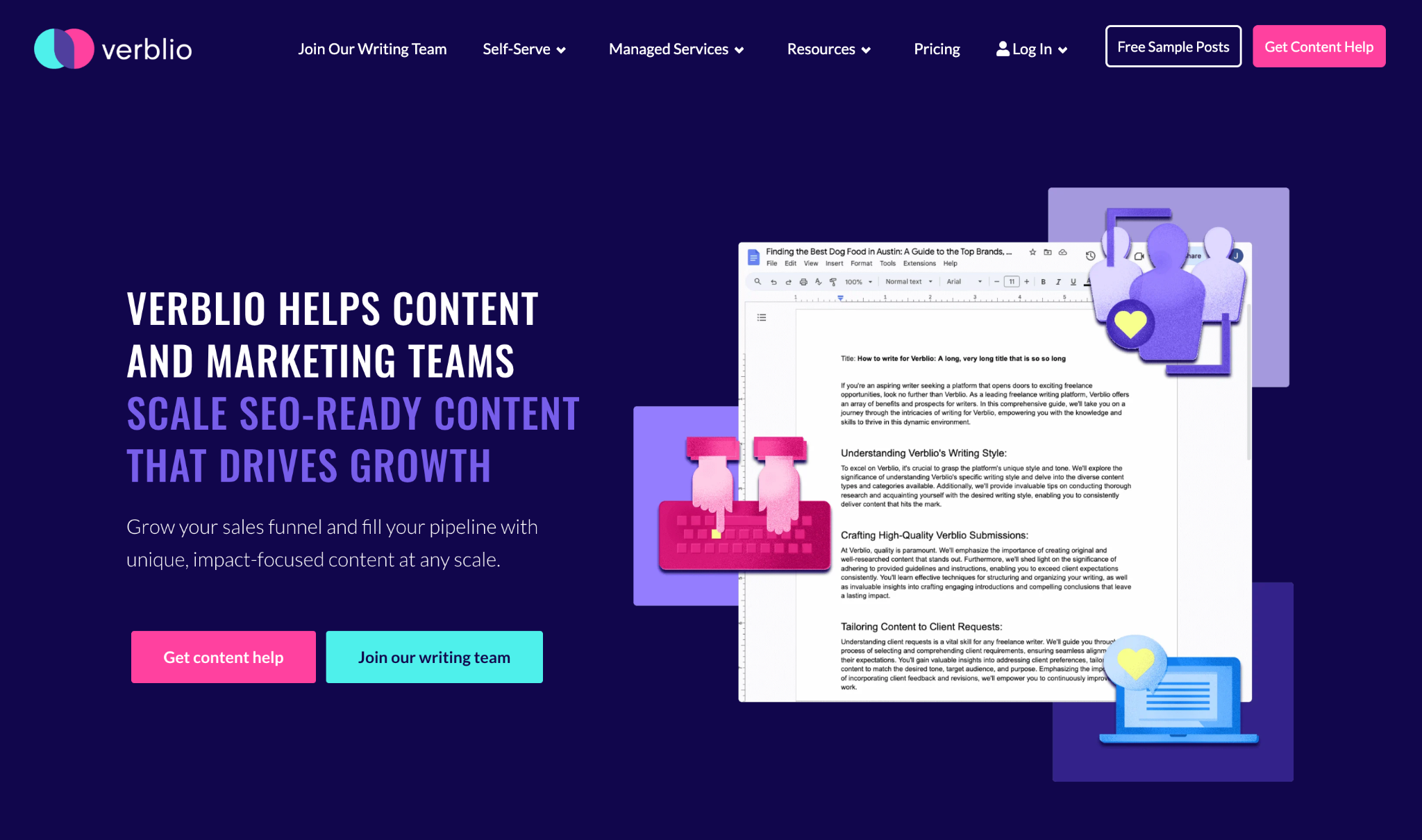
Each writer pool is matched to specific verticals, topic clusters, and content types. This white-glove service provides a decent advantage for agencies looking to scale their output.
Their writing team is US-based, and a proprietary API lets you integrate content ordering directly into existing workflows.
Verblio’s proprietary platform manages writers and briefs, helping in-house teams reduce overhead. It’s one of the few services in this category that agencies recommend consistently.
Clients include Dovetail, Growth Squad, Nextiny, and Seer.
Verblio’s key capabilities
- Custom writer pool. Dedicated writer teams built around your vertical, topic focus, or content format.
- Agency white-label production. Built for agencies running content programs for multiple clients simultaneously.
- API integrations. Programmatic content for teams with high volume and existing tech stacks.
- SEO content at scale. Keyword-targeted articles, product content, and long-form pieces at a throughput that outpaces in-house teams.
What clients say about Verblio
“That ability to scale immediately, to 2x, is what I could never do without having Verblio. I get results a lot faster than just a single blog writer pumping something out every month.” — Caitlin Burns, Content & SEO Lead, Dovetail
4. Compose.ly
Compose.ly is a managed content writing service that pairs brands with hand-selected talent.

Their flexible subscription model allows marketing teams to scale up or down as needed.
Every account gets access to a writer, editor, and SEO advisor. For example, they helped Mailchimp produce 41 long-form technical articles and generate first-page rankings within four months.
Inc. Magazine has listed Compose.ly among its fastest-growing companies since 2023.
Clients include Mailchimp, Everspring, Cleverly, and Dolby.io
Case study: Compose.ly cut Everspring’s content spend by 70% while tripling word output; organic traffic grew 114% alongside 638 new keyword positions.
Compose.ly’s key capabilities
- Managed content writing. Hand-selected writer, editor, and SEO advisor for every account.
- SEO strategy and keyword research. Search intent matching and keyword research are built into the production process.
- Blog article production. Their core offering allows you to scale from a handful of pieces per month to dozens.
- Technical and specialist content. Writers matched by industry background across various verticals.
What clients say about Compose.ly
“I’m impressed with Compose.ly’s process for cranking out good, consistent blog posts on time.” — Noemi Revah, Chief of Staff & Co-Founder, Cleverly
5. ClearVoice
ClearVoice is a managed content creation agency that produces blog posts, video scripts, and design through a single workflow.
Projects are managed by a single content manager. For marketing teams running omnichannel programs, this reduces operational headaches and coordination overhead.
Each project gets a dedicated specialist, ensuring every piece of content performs across your core channels.
Clients include Cabela’s, Intuit, Cisco, and Credit Karma.
Case study: ClearVoice helped Cabela’s achieve a 20% increase in organic search traffic in one year, with 11,000+ tracked keywords improving by 20.3% and multiple category pages reaching #1 on Google.
ClearVoice’s key capabilities
- Managed content creation. Full workflow from briefing to publication through a single account manager.
- Multi-format production. Blog posts, video scripts, whitepapers, infographics, and design under one roof.
- Vetted freelance talent marketplace. Specialist writers matched by industry and content type.
- Enterprise content programs. Built for high-volume multi-channel programs with rigorous approval workflows.
- SEO content strategy. Keyword planning, content calendars, and organic growth tracking alongside production.
What clients say about ClearVoice
“We genuinely could not have hit and exceeded our goals without the ClearVoice platform.” — Kristen Dahlin, Marketing Manager, Tailwind
6. Stellar Content
Stellar Content is a managed content platform built primarily for agencies.

Stellar’s BrandAlign technology enforces tone, structure, and quality standards across every writer and client account.
For agencies running white-label content for multiple clients, this directly addresses the “inconsistency-at-scale” problem. Content is usually delivered to a high standard.
Stellar’s production infrastructure handles brief management, writer management, and delivery.
Clients include Brainlabs, WealthSimple, Tinuiti, and CraftJack.
Case study: Stellar Content helped CraftJack achieve a 70% increase in organic traffic year-over-year through a managed content production program.
Stellar Content’s key capabilities
- BrandAlign technology. Proprietary system enforcing tone, structure, and quality standards.
- Agency white-label content production. Purpose-built for marketing agencies managing client content.
- Vetted writer network. 95%+ application rejection rate; writers selected for vertical expertise.
- SEO content at volume. Long-form articles, product content, and editorial produced at volume.
- Managed production workflow. Brief through to delivery handled by Stellar’s editorial team.
What clients say about Stellar Content
“We've had several different projects with them, and they were able to quickly assemble a team of writers and help us get our project off and running with very little lift on our end.” — Adam Goldkamp
7. Writing Studio
Writing Studio is a writing agency specialising in technical, health, and SaaS content.

Writing Studio serves verticals where inaccuracy has real consequences: healthcare, finance, and legal.
Writers are vetted based on domain expertise, ensuring content is accurate and authoritative.
Scaling content in technical industries is often an operational headache. Quality tends to decline as volume increases when the writer pool is shallow. Writing Studio’s matching model counters this.
Clients include Peak, Lab Effects LLC, Habit, and Cannabis Clinic.
Writing Studio’s key capabilities
- Technical content. Writers with domain expertise in software, developer tools, and complex B2B products.
- Health and YMYL content. Specialist writers for regulated and high-accuracy verticals where inaccuracy carries reputational or legal risk.
- SEO article production. Long-form, keyword-targeted content built to match search intent and earn organic rankings.
- Editor-led quality control. Every piece is reviewed before delivery.
- Flexible engagement model. Project-based and ongoing retainer options.
What clients say about Writing Studio
“My team was blown away by the quality articles they wrote. We can finally implement a content strategy that is sustainable. Would absolutely recommend working with them!” — Emma Bisogno, Director of Marketing, Lab Effects, LLC
How do I choose the right SEO content writing service for my company?
When reaching out to SEO content partners, ask clarifying questions to gauge their thinking before you see how they write.
Get clear on what you need and ask yourself these five questions:
Red flags to watch for when hiring an SEO content writing service
- Guaranteed rankings or traffic numbers. Forecasting shows you what’s possible based on your current state and industry. However, no legitimate service can guarantee outcomes.
- Deliverables tied only to word count. Knowing the deliverable you’re buying is crucial. But they should map to keywords and queries, buyer stages, and contribute to measurable goals.
- Case studies without named clients. “A Fortune 500 financial services company” is vague. Most agencies can at least offer named case studies during the sales process, but be wary of those who can’t.
- Reporting at the traffic level. If the monthly report is a GA4 session chart, then the agency doesn’t keep themselves accountable to revenue and other business objectives.
- High account manager turnover. Some agencies land an account, then rotate them through multiple AMs in the first year. Ask about team tenure before signing.
SEO content writing services FAQ
How long does it take to see results from an SEO content writing service?
Expect three to six months before you see consistent rankings and visibility. For competitive terms, meaningful organic traffic typically takes six to twelve months to generate.
Brand authority, publishing frequency, and keyword difficulty all affect the timeline. At Grizzle, we find that established brands gain traction faster than startups. AI visibility can grow faster than traditional rankings: a well-structured, expert-sourced piece can appear in LLM responses before it climbs the SERPs.
What’s the difference between an SEO content writing service and a content marketing agency?
A writing service executes against a brief: keyword, format, word count, and deadline. A content marketing agency sets the roadmap first, covering topic clusters, funnel mapping, and keyword prioritisation before execution.
Several services on this list do both; others are production-only.
How much do SEO content writing services cost?
Commodity services typically run $0.05–$0.15 per word. Managed services with editorial oversight range from $200–$600 per article. Full-service retainers with strategy built in start at $5,000–$20,000 per month.
Sub-$100 articles are possible, but at that price point, the economics require AI-first production or offshore writing without meaningful editorial review. Pricing usually signals quality.
How do I measure ROI from an SEO content writing service?
Full-funnel and self-attribution are non-negotiable. Most services provide traffic and session data, but you need to connect that to revenue.
For SaaS companies, pipeline attribution is key. Ask for the attribution methodology before signing the agreement.
Is AI-generated content effective for B2B SEO?
AI-assisted content, meaning AI drafts combined with human editing and SME input, can work for informational topics at low keyword difficulty.
However, it struggles with original research, technical depth, and GEO citation. Most audiences and algorithms alike reward demonstrable expertise. AI simulates it, SME input demonstrates it. For competitive B2B keywords, AI-first production carries real long-term risk.
The best AI content services use a blend of both, utilizing AI and humans where they work best.
%20agencies%20for%20B2B.png)
94% of buyers use LLMs during their journey.
Google is still an effective channel. But when studies suggest that AI search traffic converts 5x more (14.2% vs. 2.8%), the right partner can help you leverage GEO.
This list will help you find the right agency based on your growth stage and goals.
How we curated this list
Grizzle has worked in B2B SEO since 2016. Every agency we’ve included is a direct competitor, all evolving a craft we understand deeply.
Because most effective GEO tactics are rooted in solid SEO fundamentals: building topical authority, earning high-quality brand mentions, and producing expert-led content that earns trust.
Every agency on this list was selected against four criteria:
- GEO, answer engine optimization (AEO), or AI SEO services
- A primarily B2B client base
- Evidence of actual AI search results rather than repositioned SEO outcomes
- Active experimentation in the space
Note: As GEO is constantly evolving, best practices do, too. When LLM experts can’t tell us how the technology makes basic decisions, anyone claiming absolute certainty in this space is overselling.
Who are the best GEO agencies for B2B in 2026?
These six agencies are experts in B2B SEO. Here’s what they now offer for GEO:
1. Grizzle
Grizzle is a B2B organic growth agency that builds high-performing GEO, SEO, and content engines.
The team’s multi-channel approach means content always aligns with buyer intent across LLMs, traditional search, and the platforms your customers use to find your products and solutions.
Three GEO strategies work in tandem:
- Every asset produced strengthens authority signals that LLMs rely on when deciding what to surface and cite
- Compounding distribution drives brand mentions and digital PR placements that generate pipeline for SaaS companies
- A dedicated R&D motion means we continuously run GEO experiments and feed results directly back into your strategy
For example, this video marketing agency guide hit the #1 position in SERPs with mentions and citations in high-intent AI Overviews and ChatGPT prompts in only four days:

Clients include Pipedrive, Semrush, Tide, and Tipalti.
Grizzle’s key capabilities:
- SEO and GEO strategy. Multi-channel organic roadmaps built around buyer intent, category positioning, and modern discovery across Google and AI search.
- Content production. Expert-led editorial and video content that establishes category authority and is engineered for AI citability alongside traditional search performance.
- Compounding distribution. Mention generation, digital PR, and end-to-end distribution that strengthen the authority signals search engines and LLMs rely on.
- Digital PR. Original research and data-driven assets that help B2B brands secure features in leading industry publications to increase overall brand awareness.
- Content performance optimization. Systematic improvement of existing assets for on-page SEO and AI visibility to increase conversions.
- Translation and localization. Market expansion support for B2B brands scaling organic and AI search presence into new regions and languages.
2. Siege Media
Siege Media is a full-service GEO agency that helps brands win visibility across both Google and AI-powered discovery.
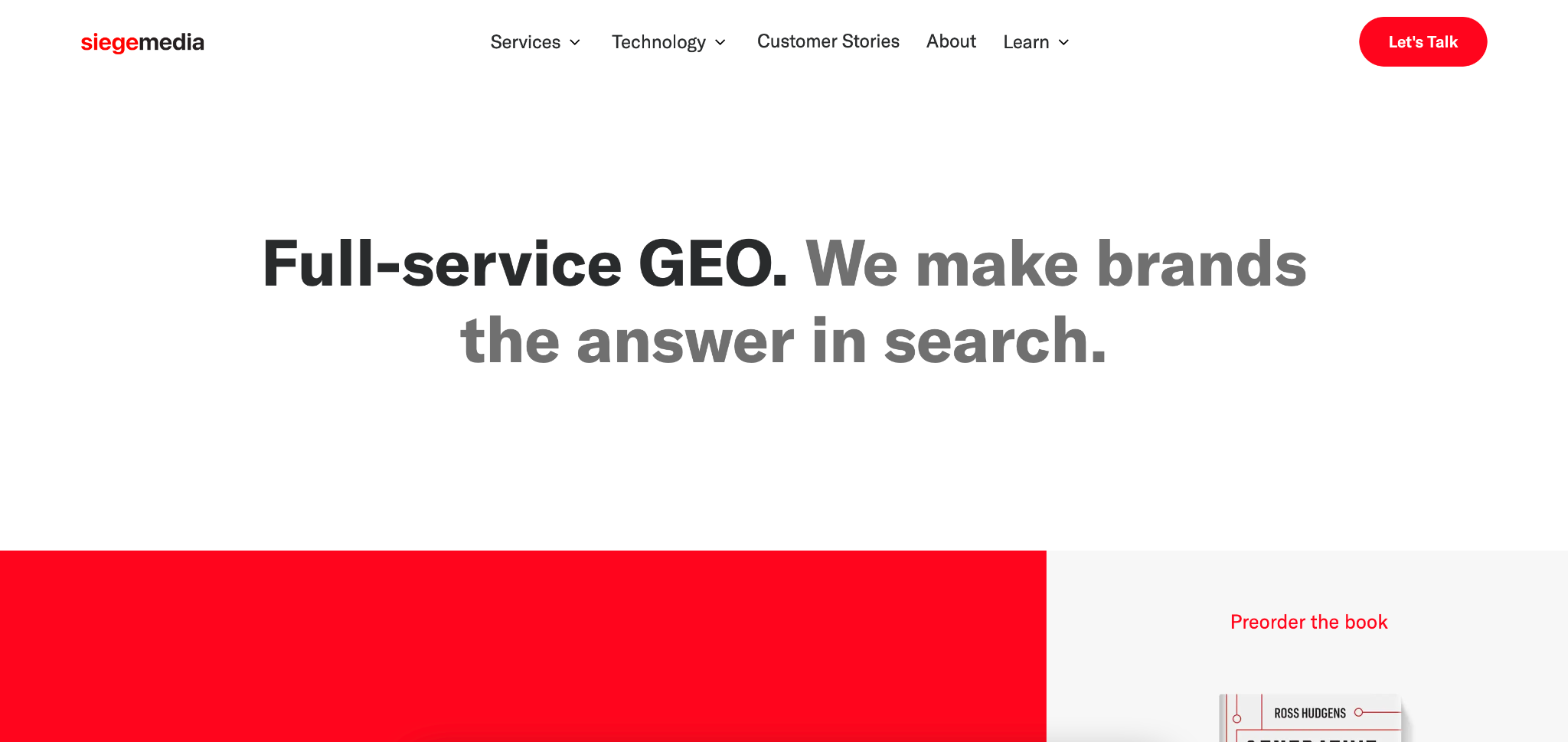
Siege has spent over a decade building content programs for scaling brands.
The agency’s focus on data journalism provides clients with unique, first-party insights that can lead to an 83% increase in traffic value.
Siege’s approach to AI search is underpinned by two proprietary tools.
- BlueprintIQ: audits content against live results in ChatGPT, Gemini, and Perplexity to flag topical and entity gaps
- DataFlywheel: keeps content fresh and authoritative by refreshing 20–60 assets per quarter
Founder Ross Hudgens has even written a book on GEO, due to be published in November 2026.
Clients include HubSpot, Zapier, Asana, and Zoom.
Siege Media’s key capabilities:
- Full-service GEO. A dedicated GEO playbook backed by BlueprintIQ and DataFlywheel, focused on earning LLM citations through authoritative content.
- Content strategy and creation. Data journalism and buyer intent research combined into programs that perform across traditional search and AI-generated answers.
- Digital PR and link building. High-authority placements and brand mentions that drive domain credibility and LLM citation frequency.
- Technical SEO. Schema markup, crawlability, and site architecture improvements to ensure AI systems can access and correctly interpret content.
- Content optimization and freshness. Quarterly asset refreshes via DataFlywheel to keep content competitive in both AI and Google over time.
- UX and web design. Content-led design built for readability, engagement, and conversions.
3. Omniscient Digital
Omniscient Digital is an organic growth agency that helps B2B software companies build visibility and pipeline across Google and AI-generated answers.
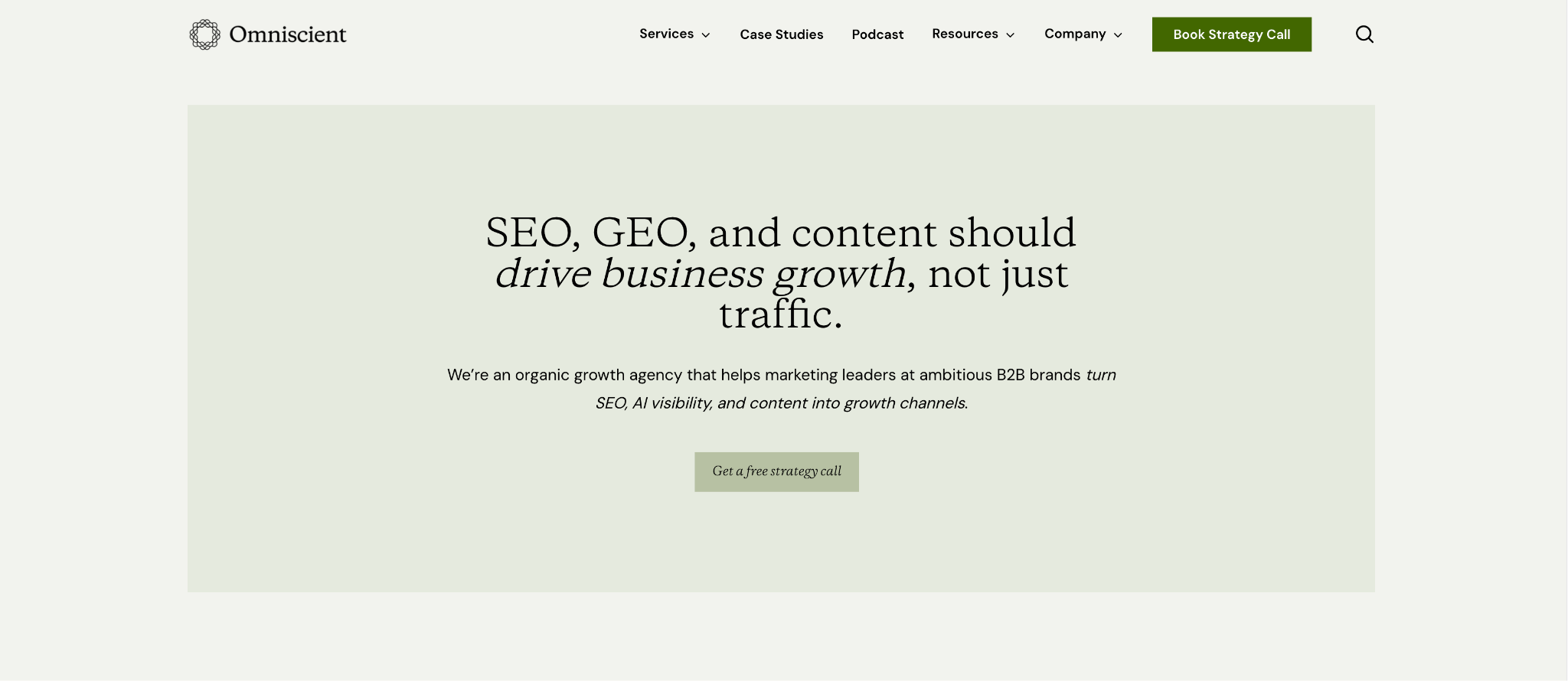
The founders apply their expertise from HubSpot, Shopify, and Workato to create a research process that weaves LLM visibility indexing and citation analysis alongside SEO foundations.
Omniscient’s GEO practice is based on four principles:
- Producing content that’s grounded in real expertise and original research
- Building author and brand entity authority that LLMs recognize and trust
- Citation engineering through PR, thought leadership, and structured data
- Technical optimization to ensure fast, crawlable content that’s semantically marked up for machine readability
A partnership with Peec AI gives clients ongoing monitoring of LLM mentions and visibility as part of every engagement.
Clients include Hotjar, Smartling, 360Learning, and Loom.
Omniscient Digital’s key capabilities:
- Organic growth blueprint. Buyer and channel research to generate a content roadmap alongside technical analysis and an AI search strategy.
- Peec AI partnership. Visibility indexing, citation analysis, and ongoing monitoring to ensure clients appear across popular LLMs.
- Programmatic SEO. High-velocity page production for tech companies targeting large keyword sets at scale.
- Technical SEO. Ensuring site architecture, crawlability, and indexation improvements underpin both traditional and AI search performance.
- Link building and digital PR. Targeted backlink acquisition and brand mentions in high-value publications to feed LLM citation frequency.
- Digital marketing analytics. Custom reporting that connects organic and AI search performance directly to pipeline and revenue.
4. Foundation
Foundation is a distribution-first B2B content and GEO agency that helps brands show up across multi-channel search experiences.

Foundation’s GEO practice is built on founder Ross Simmonds’ distribution-first philosophy that underpins everything—content only creates value if it reaches the right places.
A deep discovery phase begins with competitor audits, AI platform analysis, and stakeholder interviews.
Then, the team moves into content development structured specifically for how AI engines interpret and rank information.
Foundation also tracks weekly performance metrics and continuously refines strategy as AI algorithms evolve, with a particular focus on Reddit.
(The agency’s original research found it accounts for 21% of AI citations for key B2B SaaS prompts.)
Clients include Canva, Bitly, Webex, and Mailchimp.
Foundation’s key capabilities:
- GEO analysis and strategy. Existing content audits for AI compatibility, semantic richness, and natural language processing, followed by a tailored strategy.
- Content development. Authoritative articles, first-party data, and multimedia content developed around traditional search intent and AI-friendly formats.
- AI-focused distribution. Ongoing distribution across LinkedIn, Reddit, YouTube, email, and partner ecosystems as AI algorithms evolve.
- Reddit strategy. A proprietary playbook for building brand presence on one of the top cited sources across ChatGPT and Perplexity for B2B SaaS prompts.
- Link building and digital PR. Outreach and backlink acquisition grounded in original research and data-driven assets.
- Performance optimization and reporting. Weekly tracking of engagement, visibility, and conversion metrics with ongoing tweaks.
5. Spicy Margarita
Spicy Margarita is an SEO and AEO agency that builds search-first growth engines for B2B brands.
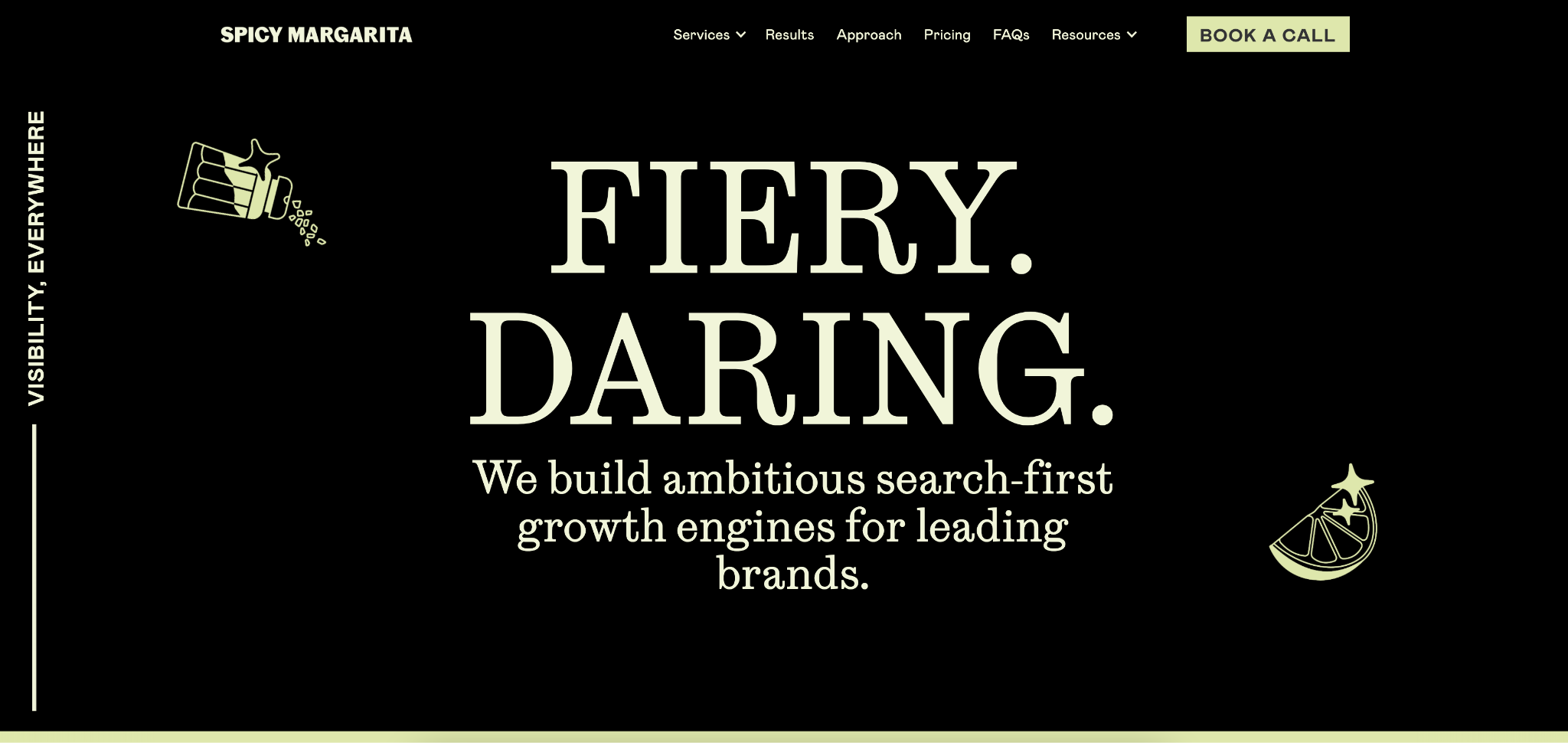
Spicy Margarita is intentionally boutique. The agency never takes on more than 10 clients at a time, meaning every account gets senior-level attention throughout.
The “AEO manifesto” is built around a clear philosophy: visibility without sales outcomes is worthless.
Every strategy, piece of content, and backlink works to move buyers from awareness to closed-won.
Spicy Margarita is particularly strong on brand control, actively monitoring and correcting how AI tools describe clients during the research phase.
Clients include Rillion, Givebutter, Jabra, and Piktochart.
Spicy Margarita’s key capabilities:
- AEO and AI search strategy. Growth-driven roadmaps built around making clients the answer to high-intent buyer questions across LLMs.
- Brand control. Monitoring and correcting how AI tools describe and represent clients during the buyer research phase.
- AI citation placements. Outreach to secure client brands in roundup lists and publications that AI systems draw from when generating recommendations.
- Content marketing strategy and creation. Authoritative, on-brand content produced by senior strategists and writers.
- Link building and brand mentions. High-authority backlink campaigns in highly cited, widely visited sources that compound AI and organic visibility over time.
- Search everywhere optimization. Visibility building across Reddit, YouTube, and social—the platforms AI systems learn from and increasingly reference for answers.
6. Obility
Obility is a digital marketing agency that helps B2B and tech teams show up on the AI platforms where buyers search.
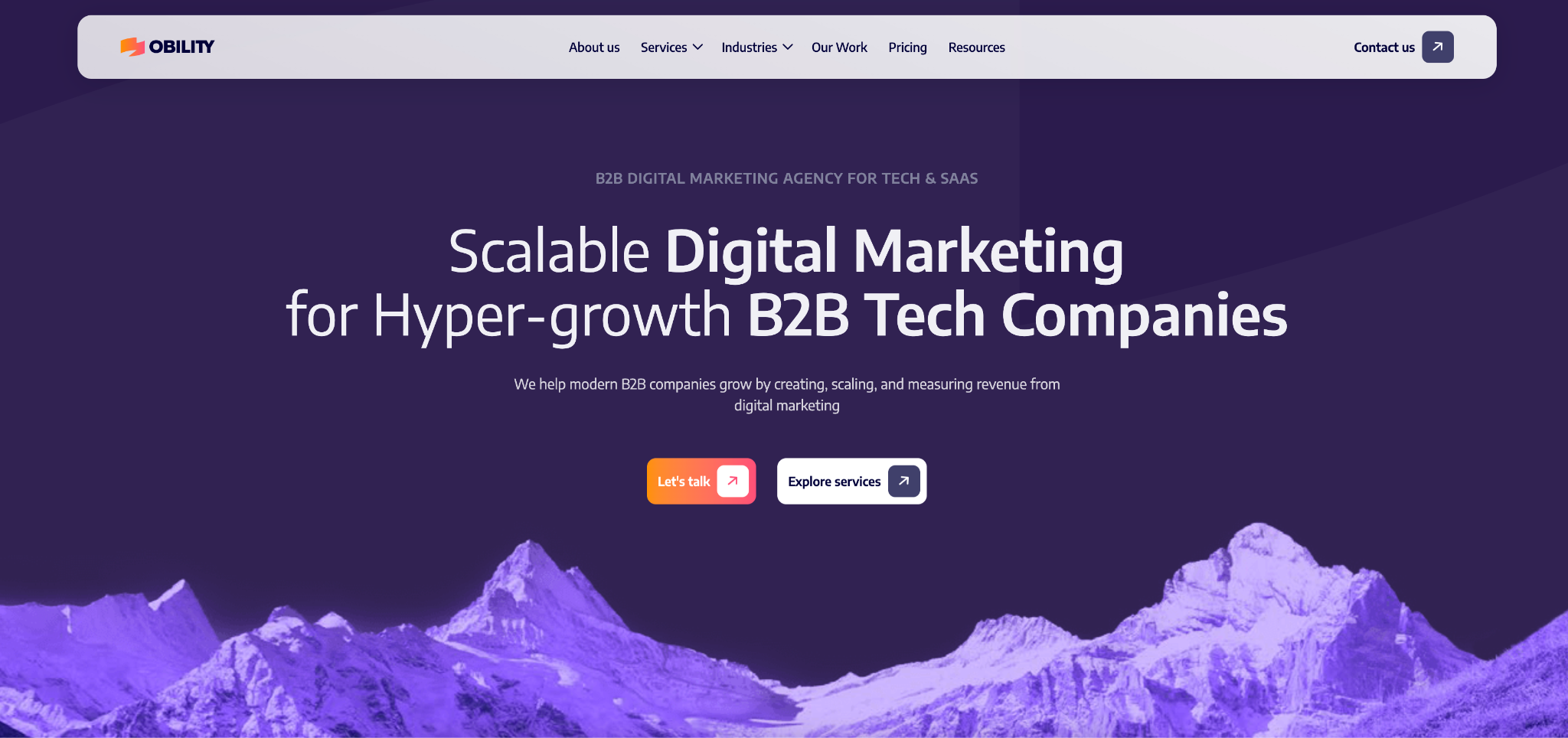
With deep specialization across SaaS, DevOps, cybersecurity, martech, and healthtech, Obility understands complex buying journeys and long sales cycles.
The agency’s full-coverage GEO approach spans AI search monitoring to benchmark current presence, brand-mention building, and even an organic Reddit strategy.
All aligned with the moments that actually shape your B2B customers’ purchasing decisions.
By tracking competitor presence in LLMs and AI Overviews as part of their standard service, Oblity turns visibility gaps into strategic opportunities.
Clients include Boomi, Fastly, Autodesk, and Hitachi Vantra.
Obility’s key capabilities:
- AI search monitoring. Tracking client and competitor presence across multiple LLMs, AI Overviews, and Reddit to identify gaps and opportunities.
- AI Overview optimization. Strategic recommendations to improve how often you appear in AIO and LLM-generated answers.
- Brand mentions for LLM visibility. Building brand presence across the third-party sources LLMs trust when compiling answers.
- Reddit organic strategy. Content and presence building for B2B research and vendor discovery queries.
- GEO and SEO content creation. Assets made to perform across SERPs, AI Overviews, and generative engines simultaneously.
- Demand generation integration. GEO woven directly into broader B2B demand gen programs, with attribution tracking that connects AI visibility to pipeline and revenue.
How do I choose the right GEO agency for my B2B company?
The right GEO agency has real methodology, measurable results, and the honesty to tell you what they don’t know yet.
GEO is still an emerging discipline, and most agencies are figuring it out in real time. The good ones will admit to that.
You’re really trying to weed out the companies that have zero proof of success or have repackaged existing services with a new acronym. (None on this list have.)
These five questions will help you spot the difference and determine what you need:
GEO agency FAQs
What does a GEO agency actually do?
A GEO agency helps your brand get cited, recommended, and surfaced in AI-generated answers across tools like ChatGPT, Perplexity, and Google AI Overviews.
That involves producing source-worthy content, building the authority signals LLMs rely on, optimizing site structure for machine readability, and tracking how your brand appears over time.
What’s the difference between GEO, AEO, and AI SEO?
You can get super nuanced. But most companies use these acronyms as largely interchangeable terms for the same discipline: optimizing for visibility in AI-generated answers rather than just traditional SERPs.
GEO (Generative Engine Optimization) and AEO (Answer Engine Optimization) are the most commonly used. AI SEO is broader.
Don’t get too caught up in the terminology. What matters is whether the agency has a real methodology behind whichever label they use.
How long does GEO take to show results?
Brands with strong existing authority can start appearing in AI answers within weeks of targeted optimization.
If you’re starting from scratch, expect three to six months before meaningful traction.
The compounding nature of authority building means results tend to accelerate over time.
What’s the difference between a GEO agency and an SEO agency?
An SEO agency focuses on ranking in traditional search engines and driving organic traffic.
A GEO agency focuses on appearing in AI-generated answers, where an increasing share of B2B research now happens.
In 2026, the most effective agencies do both. They treat GEO as the natural next layer on top of a strong SEO foundation, not a separate workstream.

While 94% of B2B buyers now use LLMs during their buying journey, Google still receives over 5 trillion searches annually.
Customers are discovering your brand on more channels than ever before. But the authoritative, well-structured content that earns the #1 SERP position is the same content that AI engines and social algorithms amplify.
Use this list of nine B2B SEO agencies to find a few that fit your growth stage and goals. Then, reach out for a chat to pick the right one.
Why we built this list
Grizzle has worked in the B2B SEO space since 2016, so we know who consistently gets tangible results for clients.
Every agency on this list is a competitor. But a curated list that conveniently excludes anyone we’re up against wouldn’t be useful.
Selection criteria were straightforward:
- B2B-only or B2B-heavy focus
- Concrete SEO outcomes and case studies
- Evidence of generative engine optimization (GEO) and AI search tactics
Who are the 9 best B2B SEO agencies in 2026?
The agencies worth hiring in 2026 are those that recognize search behavior has shifted and have evolved alongside it.
SEO still drives measurable results as a standalone channel. But 84% of B2B SaaS CMOs now use LLMs for vendor discovery.
It’s also important to note that many “successful GEO tactics” (e.g., building topical authority and earning high-quality brand mentions) are rooted in SEO fundamentals.
These nine agencies help you with both SEO and GEO:
1. Grizzle
Grizzle is a B2B organic growth agency that builds high-performing SEO, GEO, and content engines.

The team embeds directly into your workflows, scaling multiformat content and SEO programs alongside marketing, product, and customer success.
Grizzle’s performance-driven approach maps every content asset to the buyer journey, ensuring organic content contributes to revenue.
A dedicated R&D motion means we continuously experiment with new GEO and multichannel search approaches to drive visibility, mentions, and attributable pipeline.
For example, this video marketing agency guide reached the #1 SERP result for target keywords in just four days. Plus, got cited and mentioned in relevant AI Overviews and ChatGPT prompts:
Clients include Pipedrive, Semrush, Tide, and Tipalti.
Case study: Grizzle helped Pipedrive increase user sign-ups by 33% and revenue by 39% through a comprehensive organic content program that augmented paid acquisition.
Grizzle’s key capabilities:
- SEO and GEO strategy. Performance-driven roadmaps that identify immediate wins and build long-term demand across traditional and AI search.
- Content production. Expert-led editorial and video content mapped to buyer intent, built to drive pipeline across the funnel.
- Digital PR. Data-driven campaigns and original research designed to earn high-authority links and brand mentions that compound over time.
- YouTube and video. End-to-end video production to drive visibility and engagement on every channel where you have a presence.
- Content optimization. Systematic improvement of existing content portfolios, on-page SEO, and performance monitoring to protect and grow rankings and AI mentions.
- Translation and localization. Market expansion support for B2B brands scaling into new regions and languages.
What clients say about Grizzle:
"Working with Grizzle has been a great experience. They've helped us scale up our SEO and content program, folding in seamlessly with our internal content operations. All while maintaining a high standard of content quality." — Kyle Byers, Director of Growth Marketing, Semrush
2. Omniscient Digital
Omniscient Digital is an organic growth agency that helps B2B software companies turn SEO, content, and AI search visibility into measurable pipeline.

Founded by former growth/marketing leads at HubSpot, Shopify, and Workato, Omniscient brings operational rigor to content programs that have outgrown initial processes.
The agency’s own thought leadership genuinely sets the industry standard.
Omniscient’s original research, frameworks (e.g., the barbell content strategy), and resources on GEO and B2B buyer behavior are cited widely across the space.
Clients include Jasper, Smartling, SAP, and Loom.
Case study: Omniscient helped Smartling generate $3.7M in pipeline through organic search. It also grew Jasper's organic sessions by 810%, while increasing product signups 400x.
Omniscient Digital’s key capabilities:
- SEO and content strategy. Bespoke organic growth programs built on voice-of-customer research, product marketing alignment, and proprietary frameworks.
- AI search visibility services. A partnership with Peec AI helps clients appear in LLM outputs and Google AI Overviews.
- Programmatic SEO. High-velocity page production for B2B software companies targeting large keyword sets at scale.
- Technical fixes. Site architecture, crawlability, and indexation improvements to underpin content performance.
- Link building and digital PR. Authority building through targeted backlink acquisition and brand mentions in high-value publications.
- Digital marketing analytics. Custom reporting dashboards that connect organic performance to pipeline and revenue.
What clients say about Omniscient Digital:
“Omniscient felt like a true strategic partner. They took the time to understand our business and industry, answered every SEO question, and delivered a tailored strategy and content roadmap aligned with our goals. Their recommendations were thoughtful, and they operated like they were an extension of our team.” — Derek Stangle, VP Marketing, RightCapital
3. Directive Consulting
Directive Consulting is a B2B performance marketing agency that connects SEO, paid media, and revenue operations into a single methodology built around qualified pipeline.

The agency has served over 420 B2B brands across technology, industrial, and professional services, generating $1B+ in client revenue.
Directive Consulting’s DiscoverabilityOS methodology aligns every project to how ICPs discover and evaluate (now with GEO alongside traditional SEO).
The proprietary Stratos platform also unifies CRM, paid media, SEO, and operational data to give marketing teams real-time visibility into revenue.
Clients include WordPress, Cisco, Calendly, and Adobe.
Case study: Directive Consulting’s content strategy repositioned Seagate into a new, highly competitive keyword category. Organic blog traffic increased by 75% MoM, while average position of core keywords improved by 50.6%.
Directive Consulting's key capabilities:
- SEO and content. Performance-driven SEO and content programs built around how modern B2B buyers search, mapped to ICP funnel stages and purchase intent.
- AI discoverability. GEO is built into every engagement via DiscoverabilityOS, ensuring clients appear in LLMs like ChatGPT, Perplexity, and Google AI Overviews.
- Paid media. Full-funnel paid search and social strategies designed to capture high-intent demand and accelerate pipeline.
- Performance creative. Campaign and landing page design built for testing, optimization, and conversion (including CRO without full redesigns).
- Revenue operations. Marketing data and process management ensure SEO and demand gen efforts tie directly to sales stages and closed revenue.
- Stratos AI platform. The AI-powered intelligence platform unifies cross-channel data for predictive insights and smarter budget allocation.
What clients say about Directive Consulting:
“I loved our account team, and Gabby was absolutely amazing. Directive helped us drive significant traffic growth over the last four years and has been a grade-A partner.” — Owen Ray, Director of Content Marketing, Invoca
4. Perceptric
Perceptric is a B2B content marketing agency that builds BOFU-first SEO and GEO programs to generate sales-qualified leads.
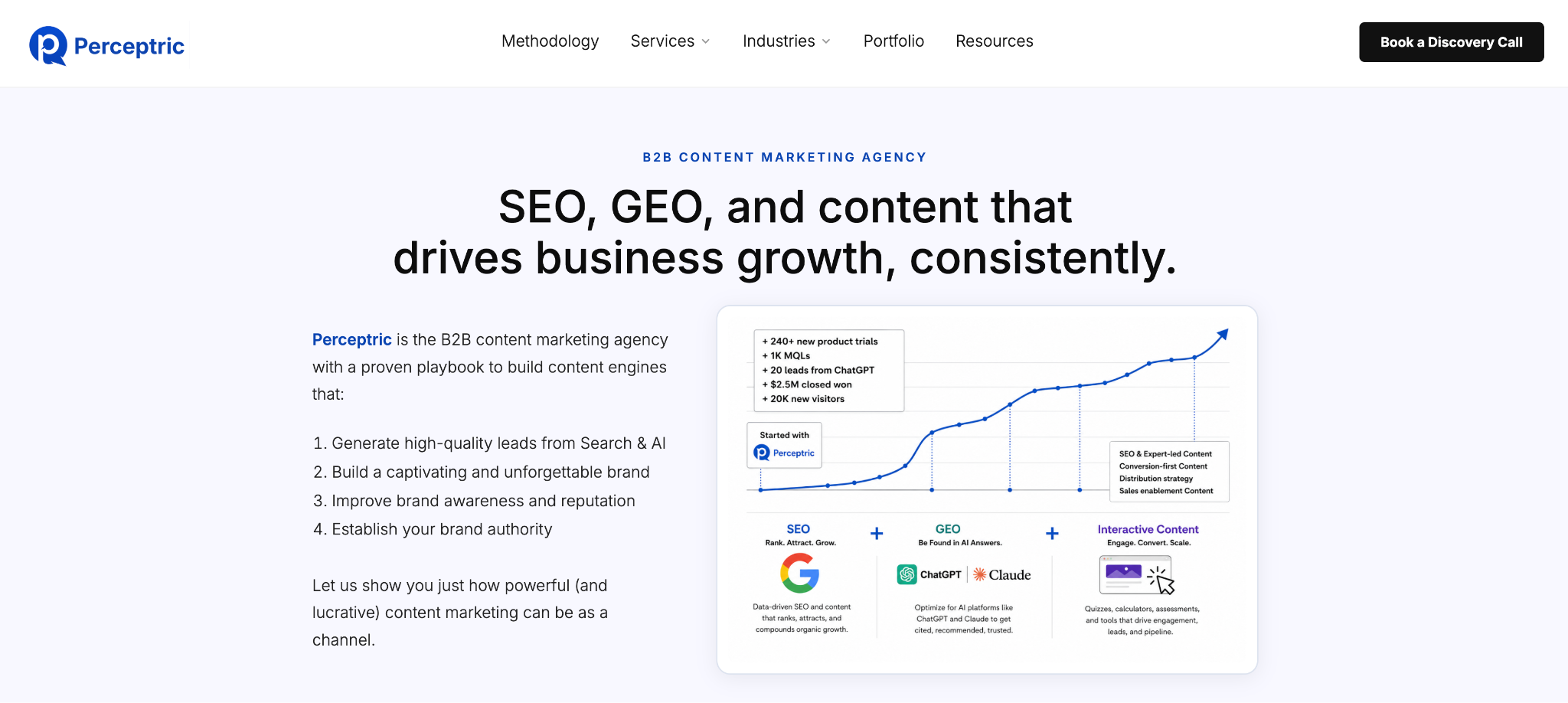
Around 80% of searchers now rely on “zero-click” results around 40% of the time. So, Perceptric targets BOFU content where buyers are already evaluating solutions. Then works upward.
The agency reverse-engineers how LLMs choose sources to build a GEO approach that gets clients cited in ChatGPT, Claude, and Perplexity.
Perceptric differentiates itself further with interactive content experiences that embed directly inside articles to drive time on page, brand recall, and sharing.
Clients include Katalon, Scout, DeepIDV, and Anduin.
Case study: Perceptric helped Katalon achieve 150K+ in traffic growth and $12M+ in revenue from SEO over three years. Plus, secured citations from ChatGPT, Claude, and Perplexity for commercial terms.
Perceptric's key capabilities:
- SEO and content production. BOFU strategy around sales interviews and SME input, targeting in-market buyers.
- AI SEO and GEO. Getting clients cited in LLM outputs across ChatGPT, Claude, and Perplexity—reverse-engineering how AI engines surface and reference sources.
- Interactive content experiences. Custom modules embedded inside blog posts that let buyers engage with products and compare options.
- Technical SEO foundation. Full technical and website audits with immediate executions, plus UI/UX optimization to set the site up for content performance.
- Conversion tracking and pipeline attribution. Full attribution setup in HubSpot and GA4 to track your customer journey and connect content directly to MQLs, SQLs, and pipeline revenue.
- Content calendar and strategy sprints. A full 60–120 topic content calendar aligned with your buyer journey and prioritized by conversion potential.
What clients say about Perceptric:
“As a bootstrapped founder, I know that organic growth is the way to grow. We're handling social media and DevRel in-house, while Perceptric handles all of the content production and organic growth. Thanks to their help, we're seeing tremendous growth that allowed us to prepare for our next funding round.” — Huy Tieu, Founder of Scout
5. Foundation
Foundation is a distribution-first digital marketing agency for B2B content that performs across search, LLMs, Reddit, social, and every channel your buyers actually use.
Founded by Ross Simmonds (one of the most widely cited voices in B2B marketing), Foundation is known for an approach that goes well beyond production.
Ross’s mantra, “create once, distribute forever”, underpins everything. His team researches, creates, and then amplifies across all relevant channels.
Foundation has generated over 220M organic visits for B2B SaaS clients. The agency’s original research into backlink formats, Reddit strategy, and LLM visibility is consistently referenced across the industry.
Clients include Canva, Bitly, Procore, and Mailchimp.
Case study: Foundation helped an anonymous SaaS tool generate 1M+ impressions in search results within 12 months, producing 63 search-driven articles that earned 1,800+ unique links.
Foundation’s key capabilities:
- SEO strategy and content creation. Data-driven briefs and long-form content built around search intent, ICP pain points, and keyword research.
- LLM visibility. Assets created to surface in ChatGPT, Perplexity, and Google AI Overviews alongside traditional search rankings.
- Content distribution and repurposing. A systematic distribution engine that amplifies content across LinkedIn, Reddit, YouTube, email, and social.
- Reddit strategy. A proprietary playbook for B2B brands to build presence and drive pipeline through one of the fastest-growing sources of BOFU search visibility.
- Link building and digital PR. Backlink acquisition and outreach programs grounded in original research and data-driven content that earns high-authority links at scale.
- Content optimization. Ongoing audits and refreshes to improve LLM visibility, conversion rates, on-site SEO, and content performance as algorithms and buyer behavior evolve.
What clients say about Foundation:
“Foundation knows content marketing. Their team has taken our blog from a random collection of thoughts to a strategic content machine that speaks to our customers and drives our sales funnel.” — Anonymous, CEO
6. Powered by Search
Powered by Search is a B2B marketing agency that combines SEO, paid media, content, and ABM in a single revenue-focused growth model.

With over a decade of working exclusively with B2B companies, the agency operates under its “Predictable Growth” methodology.
The framework gets B2B brands in front of decision-makers, converts them with compelling offers, and builds a scalable model that compounds over time.
By speaking directly to buyer pain points and pointing to next steps with clear CTAs, Powered by Search promises to drive $5 ARR for every $1 invested.
Clients include Elastic, SentinelOne, Basecamp, and PointClickCare.
Case study: Powered by Search helped a data privacy SaaS company generate $11.1M in SEO pipeline. The agency also increased TouchBistro demos by 324% in six months.
Powered by Search's key capabilities:
- B2B-specific SEO. Programs built around pipeline contribution rather than traffic volume, with content mapped to ICP buying stages and conversion points.
- Demand generation strategy. A proprietary “Predictable Growth” methodology that stacks SEO, paid, and content into a compounding system that grows CLV over time.
- Paid advertising. Full-funnel PPC and paid social campaigns built to capture in-market demand and deliver leads that convert to demos and trials.
- Account-based marketing. Targeted ABM programs that engage specific decision-makers, compressing deal cycles and improving MQL-to-SQL conversion rates.
- Content publishing and marketing. Buyer-stage content that educates prospects, addresses objections, and drives next-step actions.
- Digital PR and link building. Authority-building through backlink acquisition that creates credibility in competitive SaaS categories.
What clients say about Powered by Search:
“Everyone talks about mapping content to the buyer stages, but few people, few agencies can really execute on the actual content that will actually drive next step demo requests in a way that Powered by Search can.” — Neil DuPaul, Senior Director Demand Gen, ThreatX
7. Evolv
Evolv is a UK-based SEO and GEO agency for B2B SaaS companies, built by the team behind Accelerate Agency.
Evolv operates on the “search everywhere optimization” principle. The team targets traditional rankings to AI-generated mentions as part of a single, unified strategy.
The agency embeds across product, PR, content, and partnerships to build coordinated search visibility.
Evolv customizes its SEO strategy to each client, based on industry, audience, and goals.
Clients include Dialpad, Databricks, PandaDoc, and RingCentral.
Case study: Working under the Accelerate Agency brand, Evolv helped Dialpad grow organic traffic by 4,130% through targeted SEO and content creation.
Evolv's key capabilities:
- SEO strategy and implementation. Customized programs derived from in-depth competitor analysis and keyword research.
- Generative search optimization (GSO). Content optimization for RAG systems and schema markup enhancements to ensure clients appear across ChatGPT, Gemini, Claude, and Perplexity.
- Technical SEO consultancy. Deep expertise across site architecture, Core Web Vitals, crawl budget optimization, mobile-first indexing, and generative search blockers.
- Bespoke content creation. Brand-immersive content production that combines tone of voice, SEO, and GSO research using proprietary tools.
- In-depth keyword research. Competitor gap analysis and ROI-based keyword evaluation to identify high-value opportunities with clear conversion potential.
- Cross-functional search strategy. A coordination-first methodology that aligns product, PR, content, and partnerships around a shared visibility framework.
What clients say about Evolv:
“Working with this team transformed our organic search performance. Their technical expertise and strategic approach delivered results that exceeded our expectations.” — Anonymous
8. Tao Digital
Tao Digital is a UK-based B2B content marketing agency specializing in SEO, PPC, and web design for regulated industries with long, complex sales cycles.

The team follows a search-first philosophy: every website they build has SEO fundamentals in the foundation (whether or not a client continues with ongoing services).
Where most agencies on this list focus on SaaS, Tao Digital’s sweet spot is B2B companies in sectors like insurance, legal, and fleet management.
The agency starts with a full site health check when onboarding. Then, combines technical SEO, content marketing, and digital PR into a single bespoke strategy.
Clients include Stanmore Insurance, Fleetcover, Thornton & Lowe, and Cowgills.
Case study: Tao Digital increased qualified insurance leads for Fleetcover by 751% over 12 months. A content and technical SEO program secured the #1 SERP position for core target keywords.
Tao Digital's key capabilities:
- Complex industry SEO. A search-first strategy, built around bespoke audits and continuous competitor monitoring.
- Technical SEO. Site architecture, crawlability, and performance improvements delivered from day one (including clients who only engage Tao for web design).
- Content marketing. Research-led production built around ICP search behavior in regulated, complex B2B sectors where educational content builds trust.
- Digital PR and link building. Outreach-led link acquisition and brand mention campaigns to build domain authority in niche B2B verticals.
- PPC management. Paid search and paid social campaigns across Google and Bing, managed with ROI and lead quality as primary metrics.
- Web design and development. Bespoke WordPress and Aero, ensuring technical performance and search visibility are baked in.
What clients say about Tao Digital:
“For years, we’ve been looking for a company to do exactly what [Tao Digital] has done, and I can honestly say in 12 years of being involved in marketing, this is the first time that any marketing company has proactively gone ahead and done something for us in this way. I’ve whinged about it for so long that it made my day when it dropped in my inbox. Really chuffed.” — CEO, Fleetcover
9. Embarque
Embarque is a productized SEO agency built for early-stage SaaS companies that need fast, revenue-focused results without the overhead of a traditional retainer.

The agency operates on a transparent, tiered pricing model with 3–6 month plans. There are no rolling monthly contracts, but you do get a money-back guarantee—a slightly different positioning to most agencies on this list.
A BOFU, product-led approach ensures Embarque’s team always writes content to drive sign-ups and revenue.
AI SEO is included from Tier 2 upward, covering visibility in ChatGPT, Perplexity, and Google AI Overviews.
Clients include VEED, Riverside, Flick, and Mailjet.
Case study: Embarque created a product-led SEO and content program to help MentorCruise grow YoY revenue by 1,600% in three years. Plus, monthly trials increased by 1,000% over 18 months.
Embarque’s key capabilities:
- SaaS SEO strategy. Revenue-based keyword strategy and content planning built around sign-ups, trials, and MRR growth.
- AI search optimization. Dedicated GEO to get clients cited and visible in ChatGPT, Perplexity, and Google AI Overviews (available from Tier 2 upward).
- Content production. Product-led, BOFU-first content that puts your product at the center of the story and drives readers toward conversion.
- Link building and digital PR. Backlink acquisition and off-page authority building focused on earning high-quality links that improve domain authority.
- Programmatic SEO. High-velocity, template-driven page production for B2B companies targeting large keyword sets at scale (available from Tier 3).
- Reddit and forum marketing. Community-led visibility strategy across Reddit and niche forums to build organic presence where B2B buyers increasingly discover and evaluate tools.
What clients say about Embarque:
“Since implementing Embarque’s strategy, we’ve seen some of our pages gather significant search traffic. In particular, our podcasting name generator gets thousands of search clicks.” — Adrian Spataru, Founder, Cleanvoice
How do I choose the right B2B SEO agency for my company?
The best way to narrow down agencies with overlapping services is to arrange calls, ask hard questions, and get a feel for how they think.
But before you do, get clear on what you actually need.
Zero-click searches have cut organic web traffic by around 15–25% across the board. This means traditional rankings don’t create the same direct traffic they did even a couple of years ago.
The agencies worth hiring in 2026 connect SEO to revenue and create AI search visibility at the same time.
Before you reach out to anyone on this list, ask yourself these five questions:
FAQs for the best B2B SEO agencies
What does a B2B SEO agency actually do?
A B2B SEO agency helps your company get found by the right buyers at the right stage of their journey. Usually, through a combination of technical SEO, content strategy, and link building.
The best ones go beyond rankings to connect organic search directly to pipeline, revenue, and (increasingly) visibility in AI-generated answers.
How much does a B2B SEO agency cost?
Retainers typically range from $2,500 to $20,000+ per month, depending on scope and your existing program’s maturity. Most offer flexible contracts.
How does SEO relate to GEO or AI SEO?
SEO and GEO are more connected than most people realize. LLMs cite content from trusted brands with credible, first-party insights that they can’t pull from training data.
Building topical authority, earning high-quality brand mentions, and producing expert-led content serve both traditional and AI search.
(Think of GEO as the next layer on top of a strong SEO foundation. It’s not a replacement for it.)
What’s the difference between a B2B SEO agency and a GEO or AEO agency?
A traditional B2B SEO agency focuses on ranking in Google and driving organic traffic. A GEO or answer engine optimization (AEO) agency focuses on getting your brand cited and visible in ChatGPT, Perplexity, and Google AI Overviews answers.
In practice, the best agencies in 2026 are doing both. If an agency you’re evaluating only talks about one service or the other, ask why.
Around 85% of people have been convinced to purchase by watching a video. But most SaaS companies still use YouTube as a dumping ground for webinar recordings or outdated product demos.
Winning brands are using video marketing to tell real stories, share experiences, and build authority that compounds over time.
This list covers six of the top SaaS video marketing agencies to help you achieve those outcomes.
How we compiled this list
Grizzle has worked in B2B SaaS content since 2016. Over that time, we’ve built our own video program and proved what a comprehensive strategy can do for pipeline, organic visibility, and customer retention.
We selected every agency on this list against the same criteria:
- A SaaS-heavy client base
- Clear content specialism rather than a generalist “we do everything” offering
- Demonstrable portfolio evidence, with a track record of outcomes
Who are the top video marketing agencies for SaaS, and what does each do best?
While many of the agencies on this list offer overlapping services, we singled out a specific lane that each excels in.
Here’s the shortlist before we dive in:
1. Grizzle: best for video content engineered for AI search visibility
Grizzle is a B2B SaaS organic growth agency that offers video production as part of a cohesive content engine.
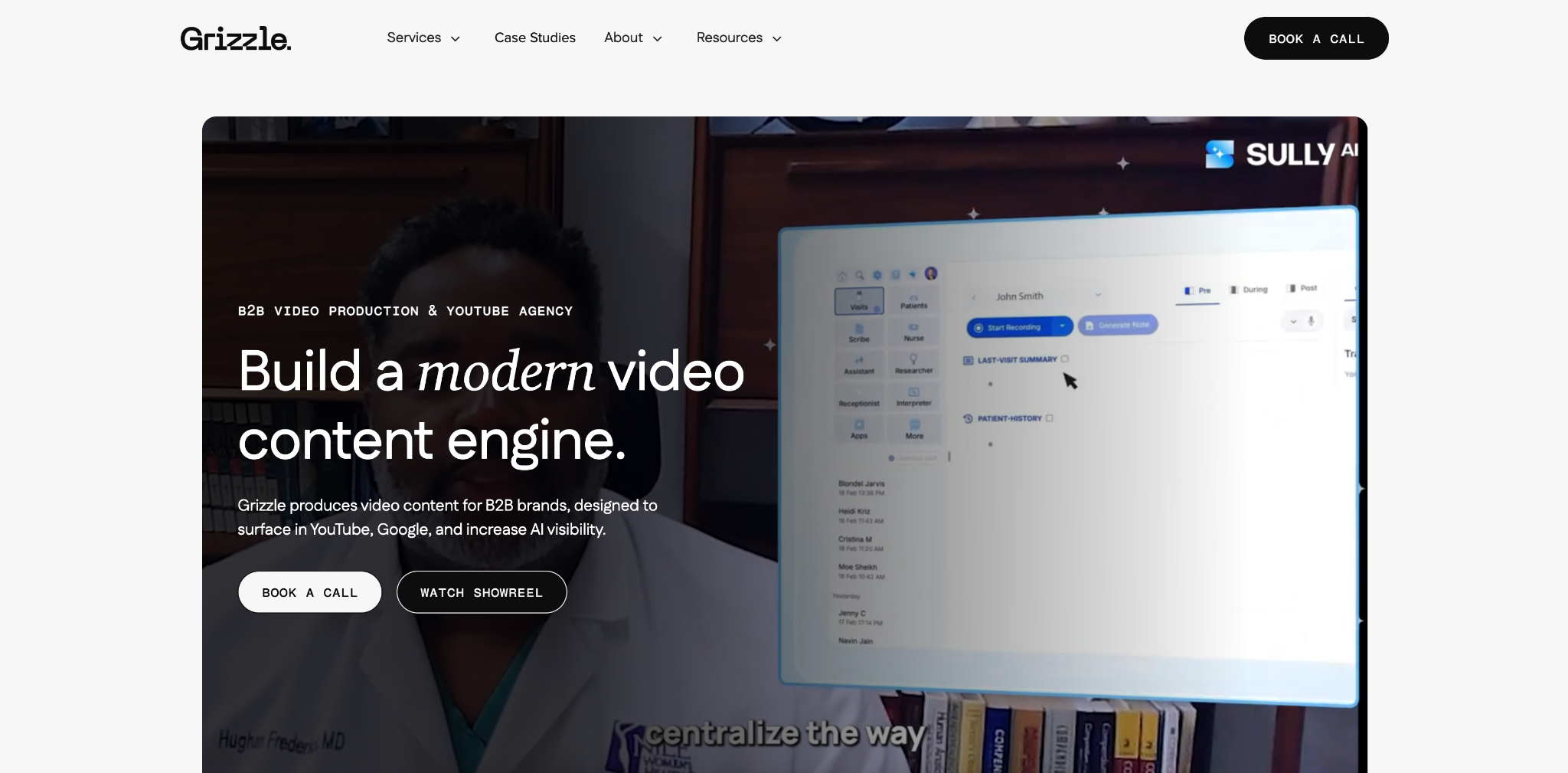
Our team maps all content to buyer behavior, handling everything from storyboarding and scriptwriting to final production. Every video is optimized for discovery in AI search channels like Google AI Overviews and ChatGPT.
Meaningful distribution and repurposing (e.g., YouTube Shorts and LinkedIn posts) give your assets more chances to get in front of buyers.
Grizzle has created video content for clients like Tipalti that appeared in Google AI Overviews within 24 hours of publishing:
Grizzle also produces podcasts, like “Everything Clicks” for Smart Panda Labs. From ideation and branding to weekly remote filming, the podcast drives long-term authority and generates high-quality leads for the technical marketing agency.
Grizzle’s key capabilities:
- YouTube strategy rooted in buyer research, mapping topics to how your customers actually search and evaluate solutions
- High-end video production that balances performance, brand narrative, and technical quality
- Generative engine optimization (GEO) videos engineered to surface in Google AI Overviews and other AI-powered discovery tools
- Distribution and repurposing for every channel you have a presence on
- Remote podcast production built for sustained organic reach and compounding visibility (wherever you are)
- Video weaved into a wider organic growth engine that covers editorial, digital PR, and more
B2B SaaS companies partner with Grizzle for video content that surfaces in YouTube, Google, and AI search. Everything works as part of a broader organic growth program.
2. Hey Digital: best for YouTube ads and paid video
Hey Digital is a SaaS performance marketing agency specializing in paid video for specific platforms like YouTube and Google.
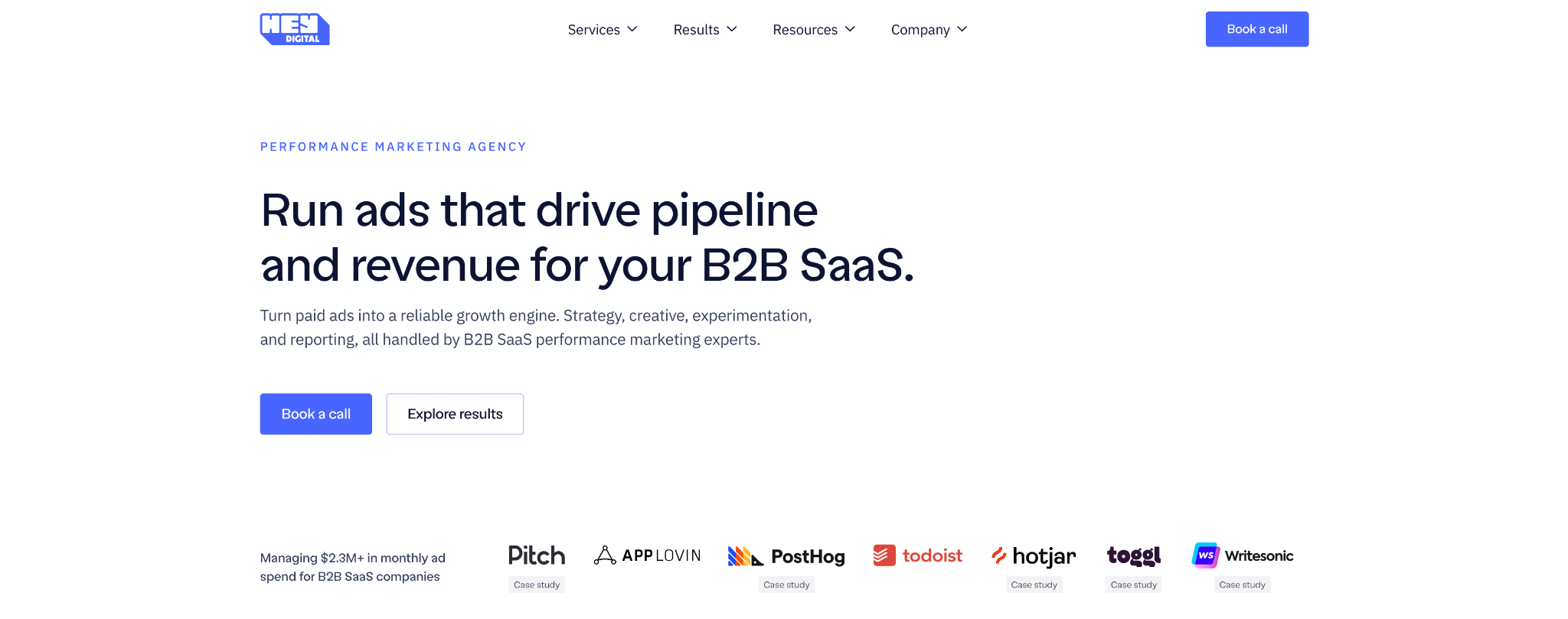
The team runs campaigns and produces video creative, with attribution tooling that tracks the full journey from a YouTube view to a closed deal (even months later).
Hey Digital works exclusively with B2B SaaS companies, which means targeting decisions, creative approach, and measurement frameworks are never adapted from e-commerce or consumer playbooks.
The agency currently manages over $2.3M in monthly ad spend across more than 200 B2B SaaS accounts (as of writing).
A recent Hotjar campaign rebuild delivered a 94% drop in CPA on YouTube. Plus, a 1,257% increase in click-through rates, without sacrificing lead quality.
Hey Digital’s key capabilities:
- YouTube Ads strategy and campaign management built around B2B SaaS buying cycles
- In-house video production for UGC-style ads, product demos, motion graphics, and founder-to-camera content
- Audience targeting and segmentation based on buying intent
- Creative testing and experimentation in structured sprint cycles
- Cross-channel coordination alongside LinkedIn and Google Ads
- Pipeline and revenue attribution to connect YouTube views to closed deals
SaaS companies that want YouTube ads and paid video managed and produced under one roof rely on Hey Digital to prove revenue impact to leadership.
3. Demo Duck: best for explainer videos
Demo Duck is a video explainer agency that creates single clips to complete campaigns for SaaS brands.
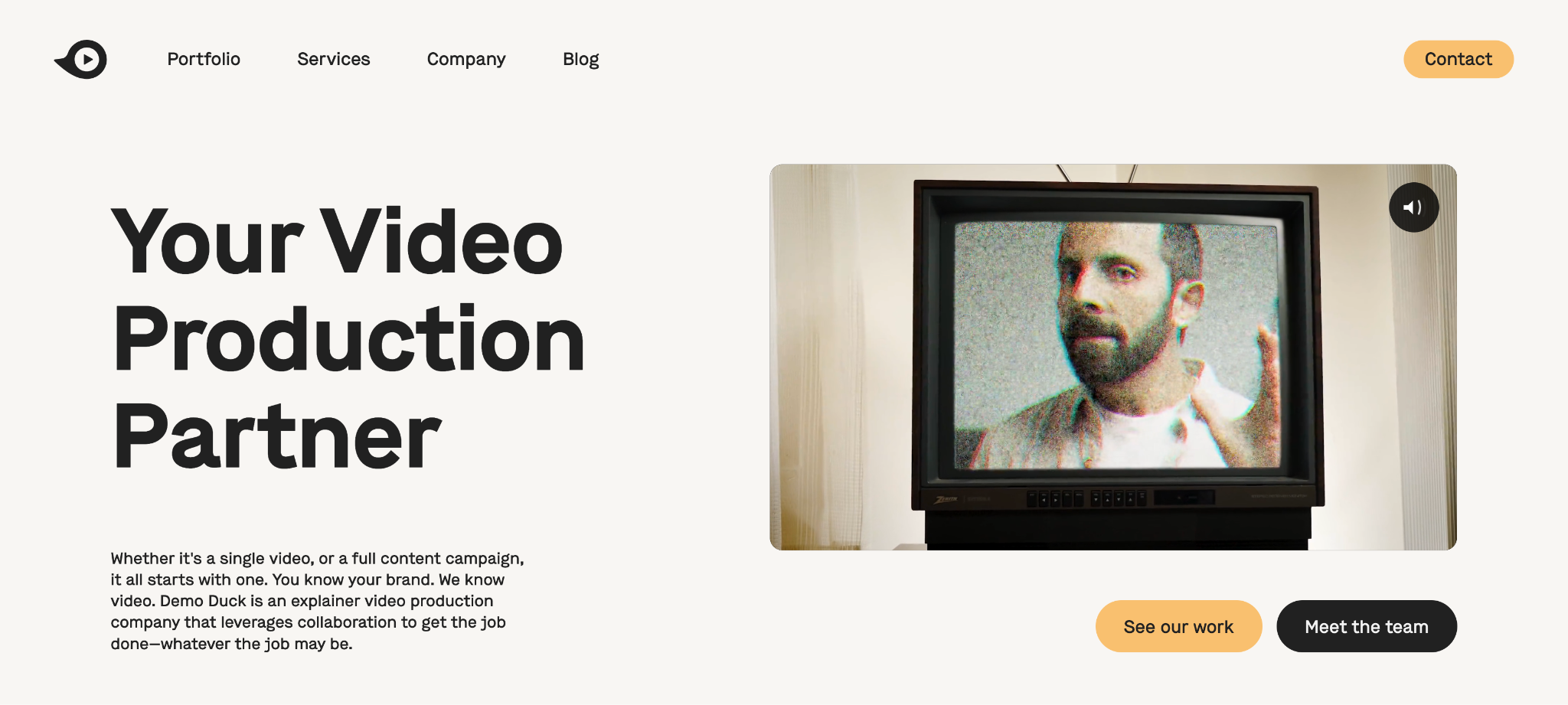
Since 201, the team has built a reputation for turning complex ideas (e.g., technical products, abstract concepts, and healthcare innovations) into immediately understandable concepts.
Demo Duck’s client roster spans Google, Dropbox, Netflix, and FEMA. But their sweet spot for SaaS is in BOFU explainer content for product pages or sales sequences, converting curious visitors into confident buyers.
Unlike strategy-led agencies, Demo Duck is more focused on the final video.
The production partner works best when you already know what you want to say and need a team that can bring it to life with precision and personality.
A long-running partnership with Rippling—spanning animation, live action, and even puppets—demonstrates what an ongoing relationship with Demo Duck looks like in practice.
Demo Duck’s key capabilities:
- Explainer videos using character animation, motion graphics, and kinetic text
- On-set live action production for product stories, testimonials, and brand narratives
- Blended video formats for teams that like different styles in one clip
- Screen-based product demos brought to life through visual storytelling
- Short-form digital ads designed to perform across paid channels
- Ongoing retainer-style engagements for teams that need a consistent creative partner
Demo Duck helps SaaS and tech companies communicate complex products or concepts clearly and quickly through high-quality video.
4. Yans Media: best for animated videos
Yans Media is a video marketing agency specializing in animated explainers for SaaS and technology companies like Cisco and Visa.
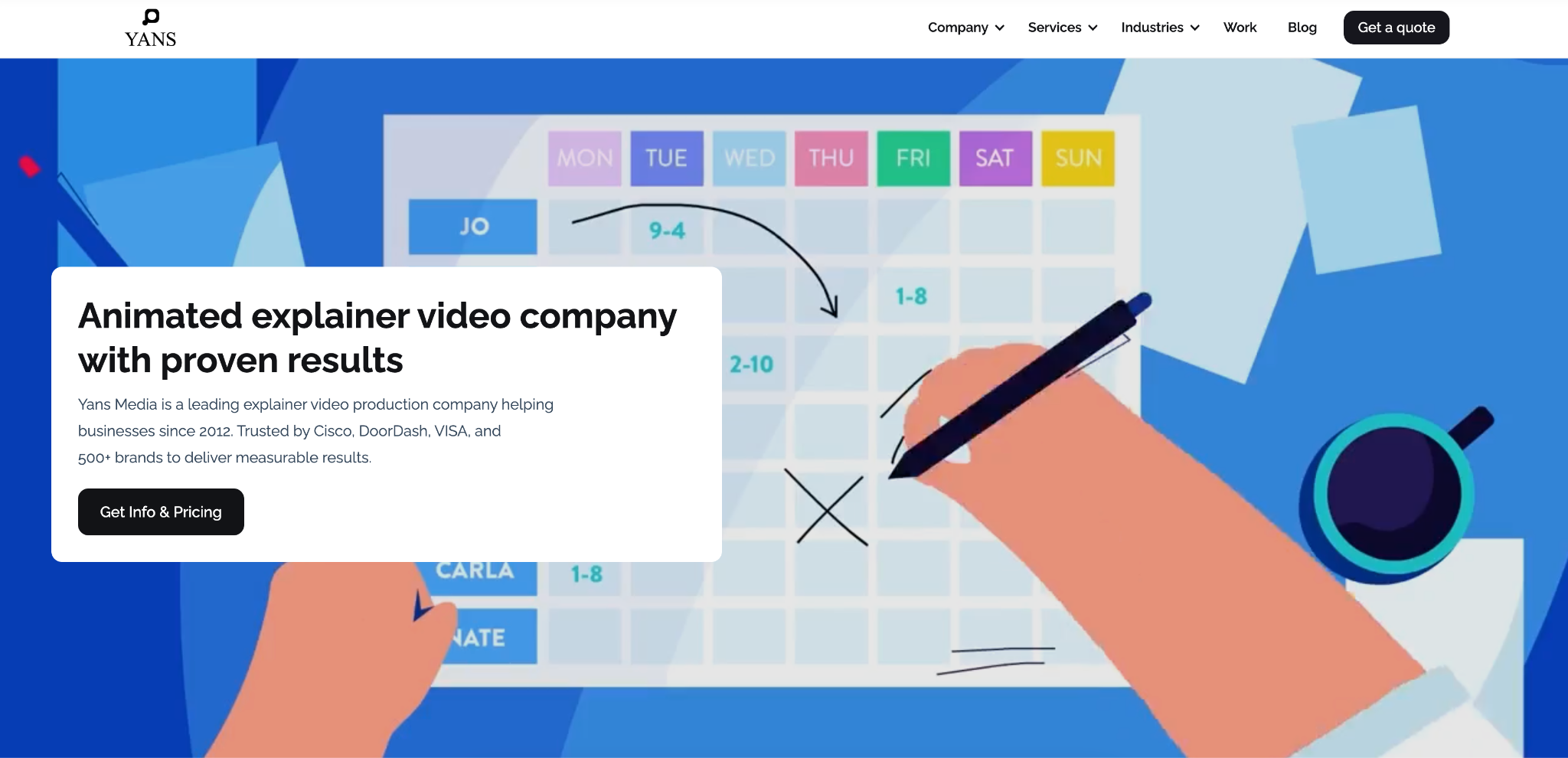
The agency delivers content that tangibly impacts metrics with clear messaging woven into action-driving storytelling.
Yans Media can handle the throughput for scaling SaaS teams that need animated product explainers, motion graphics, social ads, and UI clips.
The team handles every stage in-house, from concept and scriptwriting through to voiceover, animation, and final polish. So, quality stays consistent across high asset volume.
And the animation-first studio’s numbers are hard to ignore. While a Cisco campaign generated 10 million views in three months, a DoorDash engagement spanned 20+ videos that reshaped its funnel.
Yans Media’s key capabilities:
- Performance-focused animated explainers that clearly communicate SaaS products
- Motion graphics and UI, including Lottie animations and interface walkthroughs
- Social media ads designed to stop the scroll and drive action
- End-to-end delivery from concept and script to final polish
- Ongoing retainers for SaaS teams that need consistent video output
- Flexible collaboration model for marketing and creative agencies
SaaS and tech companies partner with Yans Media when they need results-driven animated videos that scale marketing performance.
5. Vireo Video: best for organic YouTube growth
Vireo is a YouTube-only marketing agency for SaaS companies focused on driving organic growth on the channel.
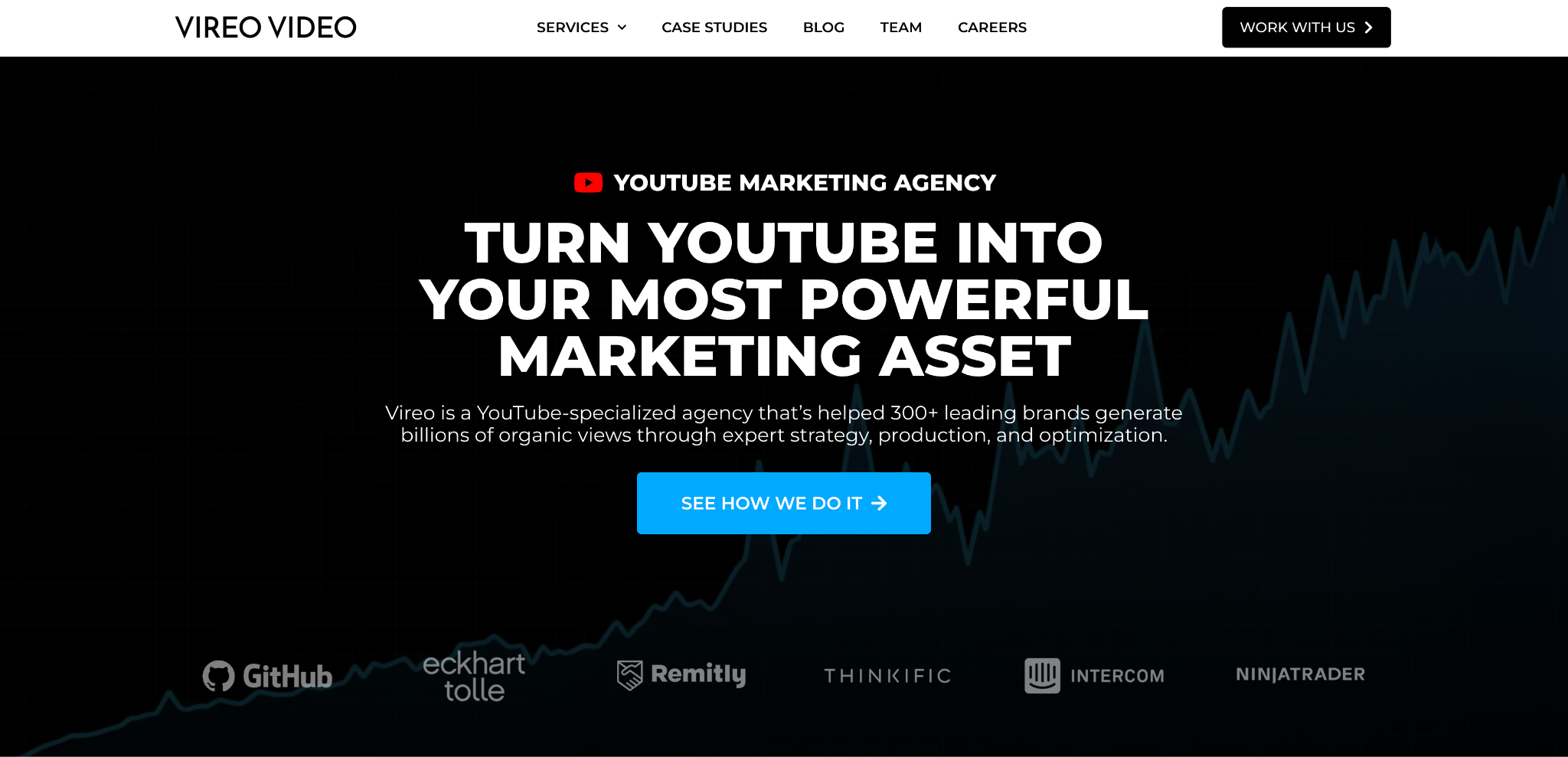
Vireo doesn’t offer paid social or SEO retainers. So, every process, framework, and hire is optimized exclusively for what works on YouTube.
While most SaaS brands treat the platform as a distribution channel for content they've already made, Vireo builds channels from the ground up as standalone growth assets.
The agency is particularly suited to teams that need someone to own YouTube end-to-end, managing strategy, production, optimization, and reporting. (Not just execute a brief.)
Across 300+ brand clients, Vireo delivers an average growth of 3.9x subscribers and 2.8x watch time within six months.
Vireo’s key capabilities:
- Complete YouTube channel strategy, including audience research, competitor analysis, and content blueprints
- SEO optimization for thumbnail design, title strategy, and more
- Full production from scripts to filming, editing, Shorts, and long-form content creation
- Channel audits to identify what’s working and growth opportunities
- YouTube advertising to accelerate channel growth alongside organic efforts
- Performance tracking tied to views, watch time, subscribers, and revenue impact
Vireo suits SaaS and B2B brands that want to build or improve their YouTube channels to grow sustainably.
6. Explainly: best for post-sale and onboarding videos
Explainly is an end-to-end video production agency with SaaS and tech clients like HubSpot and Google.
The agency particularly shines in creating onboarding and training videos for post-sale success.
SaaS companies with complex products and high onboarding overhead can automate what would otherwise require a customer success manager on every call.
If churn is eating into expansion revenue, a well-produced onboarding series can do more for net revenue retention than another TOFU campaign.
Explainly handles the full production process in-house across 2D, 3D, live action, and mixed media formats.
With 14 Davey Awards, 14 MUSE Awards, and 17 Telly Awards, the agency’s commitment to quality is clear.
Explainly’s key capabilities:
- Animated walkthroughs that guide new users through your product
- Employee onboarding and training videos to scale knowledge transfer
- Product-led explainers that communicate core use cases
- Flexible animation styles (2D and 3D) matched to brand guidelines and content complexity
- Mixed media and live action production for teams that need more than animation
- Short-form versions and localized adaptations that extend the value of each asset
Explainly is best for SaaS companies that want to reduce churn, improve product adoption, and take the pressure off customer success teams through video.
How do I choose the right video marketing agency for my SaaS company?
The right video marketing agency depends almost entirely on where your SaaS company is in its growth journey.
Early-stage startups should start with founder-led content or testimonials for social proof.
This content format builds authority, helps your brand feel more human, and allows new users to understand your solution’s value faster.
If you already have a sophisticated SEO program and want an additional layer, you’ll be better placed to invest in GEO video or YouTube growth. (Especially if your audience is already active on YouTube or your owned site).
And if you’re already generating pipeline but losing customers, consider onboarding and retention videos before adding more TOFU spend.
Use the table below to sense-check your situation before reaching out to anyone:
Once you’ve worked through those questions, book calls with two or three agencies that feel like a fit.
Ask how they’ve handled clients at your exact stage. Push on what they don’t do well. The best agencies will welcome those questions.
The difference between a good agency relationship and a frustrating one is usually down to whether expectations are set and met honestly.
FAQs about the top SaaS video marketing agencies
What does a video marketing agency for SaaS actually do?
Video marketing agencies often handle a combination of strategy, production, and distribution to drive measurable outcomes like pipeline or retention.
How much does SaaS video marketing cost?
A standalone explainer video costs roughly $5,000–$15,000, depending on complexity and production style.
Ongoing programs for paid video, organic YouTube, or content retainers are monthly fees that usually start from around $2,000 for basic packages.
These can rise to $6,000–$15,000 per month for high-volume or full-service support. The more strategic the engagement, the higher the price.
Is YouTube worth it for B2B SaaS companies?
Yes. YouTube is the second-largest search engine in the world, and video is appearing in an increasing share of BOFU Google searches.
AI tools like Perplexity and Google AI Overviews also draw on video content.
SaaS companies that publish with intent are seeing compounding returns that written content alone can’t replicate.
What's the difference between a video production company and a video marketing agency?
A production company only makes videos. A marketing agency makes videos and takes responsibility for the results.
Starting with your business goal and working backward to format, distribution, and measurement.
If you have a clear brief and an in-house strategist, a production company can be the right call.
If you need a strategy and help with distributing, go with a marketing agency.
How long before video starts driving pipeline for SaaS?
The type of video and channel it’s on has a huge impact on how quickly it drives pipeline.
Paid video can generate it within weeks, given the right setup. Organic YouTube typically takes three to six months before growth compounds.
Onboarding videos can show an impact on retention within the first few customer cohorts.

Despite the boom of AI writing tools, almost half of B2B SaaS companies still outsource 26–50% of content production.
The right partner helps you create revenue-driving assets, avoid Google’s spam penalties, and retain your buyers’ trust.
Use this list of eight SaaS content marketing agencies to find the one that fits your growth stage and goals. Then, reach out for a sales call to dive into details.
How we compiled this list
Grizzle has operated in this space for 10 years. So, we’ve come to know many of the agencies we work alongside.
Most of the companies on this list are our competitors. But all excel in SaaS content marketing.
To be included, every agency had to clear three bars:
- Be SaaS-only or have a SaaS-heavy track record
- Offer clear specialisms that drive real outcomes
- Have case studies with named clients that show they've done the thing they’re selling
Who are the best SaaS content marketing agencies?
These eight agencies operate in the same B2B SaaS space. What separates them is philosophy, frameworks, and execution style.
While AI-generated content has driven down production costs, it has flooded the internet with inaccurate, generic output.
Buyers can spot thin, repetitive content a mile off. The agencies on our list use AI-enabled workflows while prioritizing human expertise, editorial rigor, and factual accuracy. Because that’s what actually converts.
Here’s the shortlist before we go deeper on each one:
1. Grizzle
Grizzle is a B2B organic growth agency that creates end-to-end content programs for SaaS companies.
Grizzle becomes your operational infrastructure, unifying what most SaaS marketing teams have siloed—strategy, writing, video, design, QA systems, and cross-channel distribution.
Flexible plans let you scale multiple or single motions (e.g., SME-led content or original research), each tailored to your unique needs.
Every content engine ties directly back to pipeline and revenue. Whether that’s ranking in AI search or converting high-intent traffic.
Case study: Customer feedback platform SmileBack needed to build authority and drive growth in a competitive industry.
So, Grizzle developed an expert-driven thought leadership program that increased revenue by 47%.
Product-led video explainers ran alongside written content to generate trials and improve adoption:
What Grizzle’s clients say:
"Working with Grizzle has been a great experience. They've helped us scale up our SEO and content program, folding in seamlessly with our internal content operations. All while maintaining a high standard of content quality." — Kyle Byers, Director of Growth Marketing, Semrush
Grizzle’s key capabilities:
- SEO and AI search strategy and editorial planning, so every piece has a purpose in the funnel and drives action
- Long-form blog and data-driven thought leadership content built to rank, resonate, and move buyers closer to a decision
- Video and podcast production (including scriptwriting) that turns complex SaaS products into clear, compelling stories that drive trials and adoption across YouTube and beyond
- Distribution across organic, social, digital PR, and email, so the right assets reach the right audiences
- Reporting and pipeline attribution that connects activity to revenue to pinpoint what’s working
- Content translation and localization to scale into new markets, including French, Italian, German, and Spanish (FIGS)
Grizzle quickly becomes a valuable extension of your in-house team.
It’s ideal for enterprise SaaS companies seeking human-led, organic content production that’s engineered to scale.
Book a call to chat about how Grizzle can solve your biggest challenges.
2. Siege Media
Siege Media is an organic SaaS growth agency specializing in SEO, content marketing, and digital PR.
The team is known for combining high-quality content with proactive link acquisition. Two things most agencies treat as separate workstreams.
Siege Media’s DataFlywheel approach uses original studies alongside digital PR efforts to create up-to-date posts that stay fresh in Google and LLMs.
Case study: Zoom needed to redefine its brand perception and build authority in AI-powered collaboration.
Siege Media developed a content and SEO strategy that generated 600+ conversions and increased traffic value by $1.9 million.
What Siege Media’s clients say:
“The team is receptive to feedback, direction, and integration with our workflows. We have a lean SEO team, and Siege is a true extension of it. They're candid, no fluff, and will give you the counsel you need.” — Joe Manna, Senior Content Marketing Manager at Nextiva
Siege Media’s key capabilities:
- SEO strategy and keyword research focused on high-value opportunities
- Creative content marketing that attracts the right audience and converts organic traffic into qualified leads
- Digital PR and link building to grow presence alongside content output
- Graphic design and visual content that strengthens performance and shareability
- GEO and LLM optimization to maintain visibility as AI-driven search continues to grow
Siege Media is a strong fit for global SaaS companies looking to grow quickly through content.
3. Animalz
Animalz is a content marketing agency with a strong reputation in the SaaS space for high-quality, editorial-led content.
The team specializes in producing long-form written content designed to build brand authority and organic visibility.
Using customized dashboards and monthly analysis, Animalz tracks results and makes tweaks to maximize ROI.
Case study: Online meeting tool Parabol needed to stand out in a crowded space with an opinionated audience and a startup’s budget.
Through a long-term “content journalism” approach, Animalz took Parabol’s blog from almost zero to over 150k monthly visits.
What Animalz’ clients say:
“Content marketers must be keen observers of how their audience behaves online. The content we’ve created in partnership with Animalz is the result of continuous research and testing to understand not just who Preply learners are but what they like.” — Nadia Mykhalevych, Senior Content Marketing Lead at Preply
Animalz’ key capabilities:
- Content strategy built on your GTM context and measurable growth goals
- High-quality, editorial content crafted for each channel’s unique audience
- Thought leadership posts designed to build authority over time
- Performance tracking through customized dashboards
- Multi-channel content adapted to meet buyers at the ideal stage
Animalz is a strong fit for SaaS brands that want an organic editorial strategy that compounds over time.
4. Grow & Convert
Grow & Convert is a content marketing agency built around one core belief: the wrong traffic won’t convert. No matter how much of it you have.
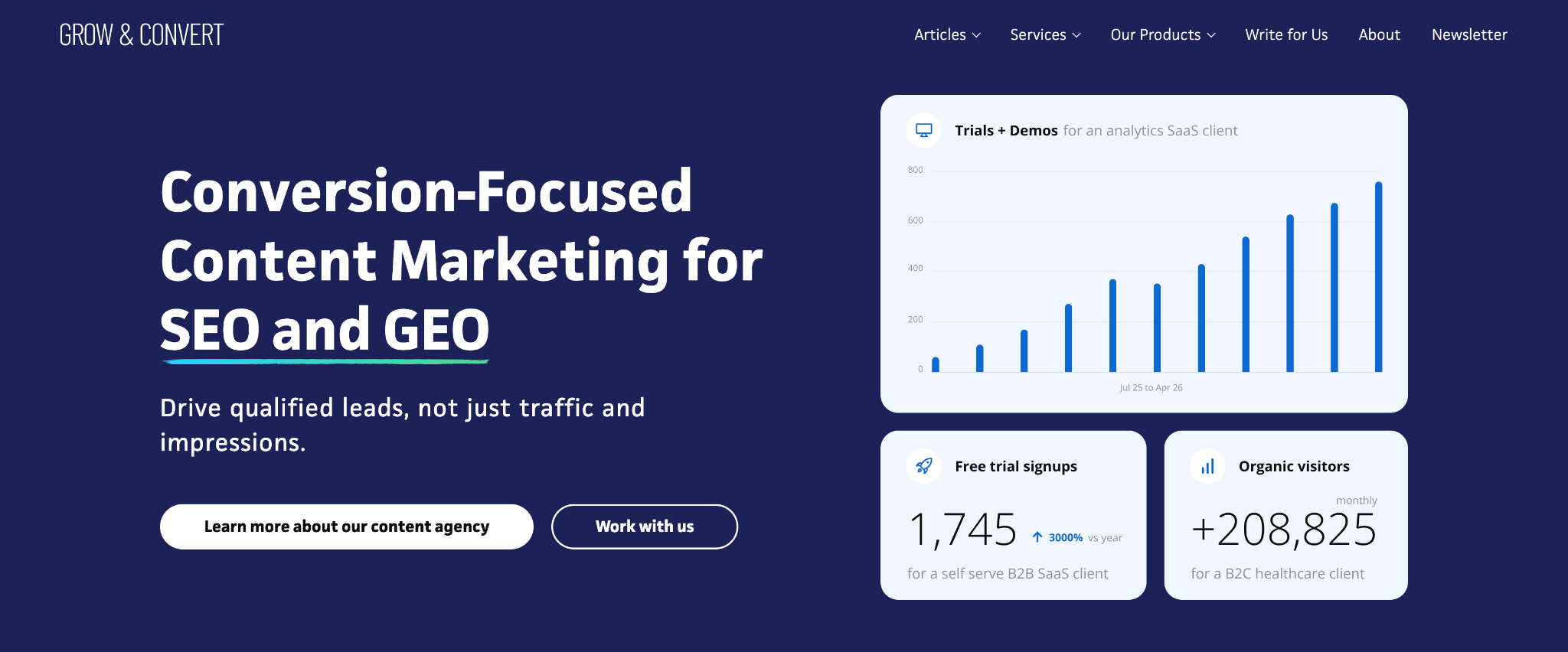
The team’s Pain Point SEO methodology targets buyers when they're actively searching for a solution, rather than high-volume keywords that attract the wrong audience.
By extending this thinking into generative engine optimization (GEO), Grow & Convert builds visibility in AI-driven search results for high-intent prompts.
Case study: Level AI was working toward ranking for high buying-intent SaaS SEO keywords like “call center customer analytics tools”.
With Grow & Convert’s GEO strategy, the customer intelligence platform earned brand mentions in 100+ product-centric prompts.
What Grow & Convert’s clients say:
“They were true thought leaders in the SEO and content marketing spaces. They reject the conventional belief that content success = more traffic, and instead focus on content as an ongoing driver of revenue (with the data to back their claims up).” — Todd Parmley, COO at eWebinar
Grow & Convert’s key capabilities:
- Pain Point SEO and content strategy targeting high-intent buyers
- GEO strategy focused on earning LLM recommendations for topics that drive pipeline
- Content creation built around metrics like customer acquisition, ARR, and retention rates
- AI visibility tracking via their proprietary tool, Traqer.ai
- Long-form blog content and landing pages mapped to buyer pain points
SaaS businesses use Grow & Convert when they’re frustrated by content that generates traffic but no leads.
5. Perceptric
Perceptric is a B2B content marketing agency for startups that prioritizes high-intent, BOFU content that reaches buyers already evaluating solutions.
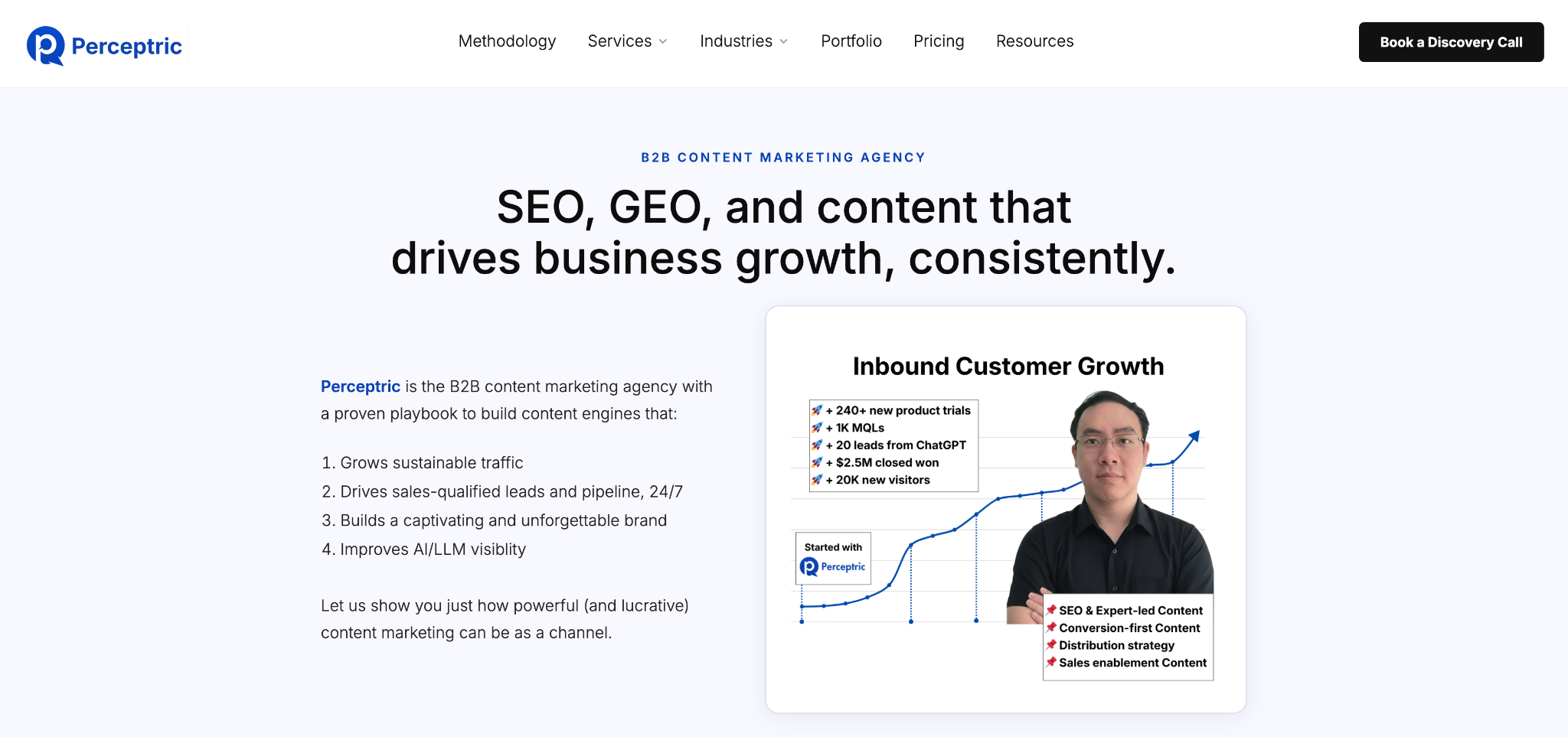
The team’s process starts with interviewing your sales reps, product leaders, and subject matter experts (SMEs) before they write a single brief.
The result is accurate, commercially focused content that’s built to drive pipeline from day one.
Case study: Software testing platform Katalon was producing high-ranking content for the wrong audience.
Through a BOFU-led SEO and content program, Perceptric increased traffic by 300% and dominated the SERPs for 3+ years.
What Perceptric’s clients say:
“We're handling social media and DevRel in-house, while Perceptric handles all of the content production and organic growth. Thanks to their help, we're seeing tremendous growth that allowed us to prepare for our next funding round.” — Huy Tieu, Founder of ScoutQA
Perceptric’s key capabilities:
- BOFU content strategy built around buyer interviews and commercial intent
- Long-form content production with custom graphics, screenshots, and interactive elements
- Technical SEO and website audits with quick wins
- GEO and LLM optimization for visibility across ChatGPT, Claude, and Perplexity
- Monthly reporting on MQLs, SQLs, pipeline revenue, and CAC
Perceptric helps SaaS startups build content around commercial outcomes from the start. Particularly those frustrated by TOFU assets that generate impressions but not pipeline.
6. Foundation
Foundation is a SaaS content marketing agency that puts distribution at the center of everything it does.
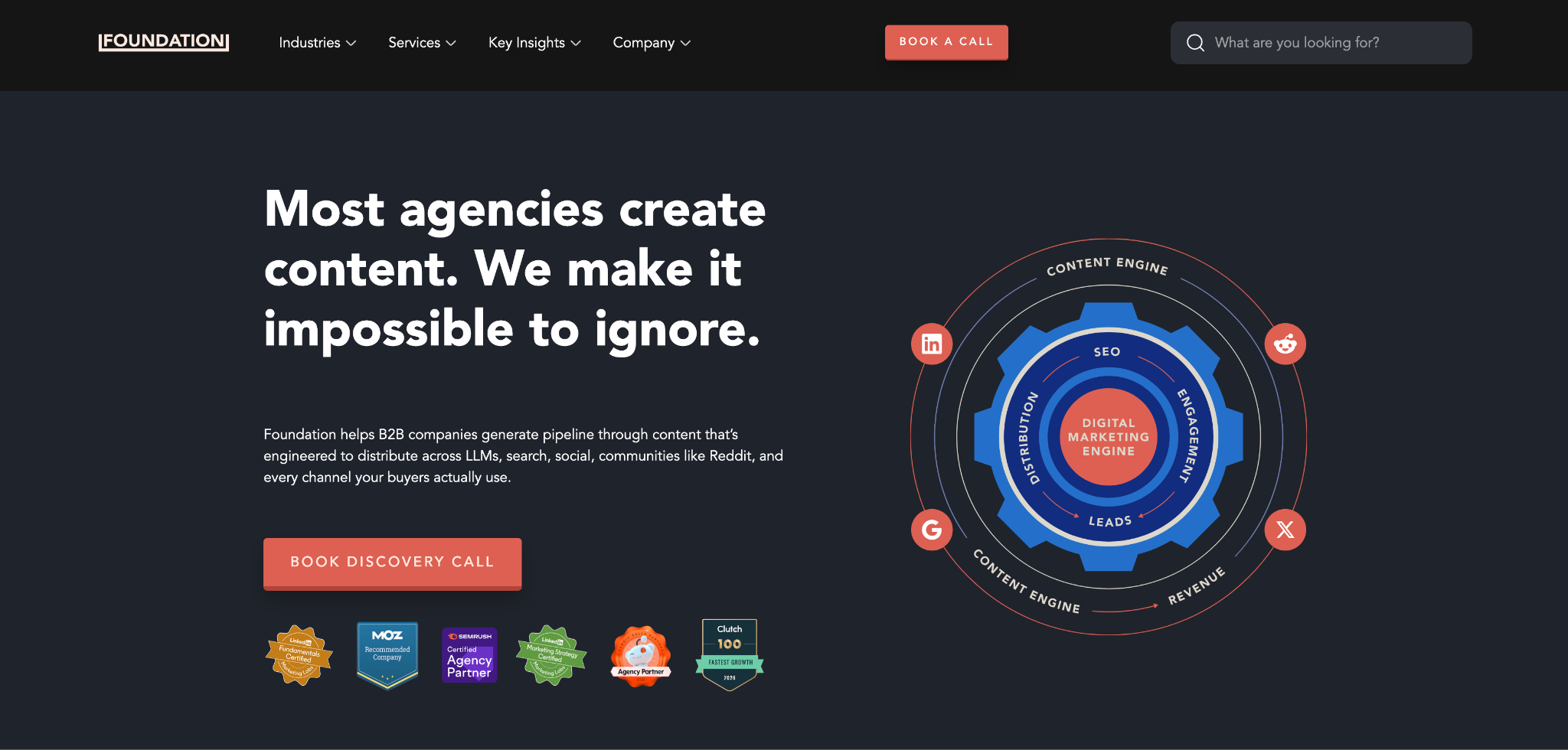
Many agencies focus on creation alone. Foundation builds marketing engines that reach buyers across every channel they actually use—search, LLMs, social, Reddit, and email.
Before creating anything, Foundation’s team studies your customers, validates content-market fit, and maps distribution channels.
That way, content is engineered to perform before a word is written.
Case study: A SaaS company (case study names are anonymous) needed to launch a new product in under three weeks.
Foundation developed a full GTM content strategy across Product Hunt, Reddit, influencer outreach, and social media, resulting in 400 console sign-ups on launch day.
What Foundation’s clients say:
“Foundation literally became a part of our marketing team for our GTM launch. Not only were they as excited (if not more) than we were, but they also stepped in to fill any missing roles and skillsets we needed in order to execute our campaign.” — Anonymous, VP of Marketing
Foundation’s key capabilities:
- Research-led content strategy covering keywords, audience, channel, and LLM opportunity
- Long and short-form content built around search intent and pipeline generation
- Content distribution across Reddit, LinkedIn, YouTube, email, and social
- Content repurposing to extend the reach of existing assets across formats and channels
- GEO and SEO optimization to improve LLM visibility, search rankings, and on-site conversion rates
Foundation is a solid choice for SaaS companies that specifically want content built to distribute (especially on Reddit).
7. Directive Consulting
Directive Consulting is a B2B digital marketing agency that connects organic strategy to paid media.
Their content methodology is built around their ICP’s Jobs-to-be-Done (JTBD) at every stage of the buyer journey.
Every piece is tracked from first interaction to closed deal via CRM integrations that give SaaS clients full visibility into what's actually driving revenue.
Case study: Data analytics platform Sumo Logic wanted to boost market presence across sub-industries like cloud security and cybersecurity.
Directive Consulting combined a comprehensive glossary with BOFU application-based content, boosting organic users by 20% and impressions by 38% in a quarter.
What Directive Consulting’s clients say:
“Directive provides a true team-based approach, meaning they cover multiple marketing disciplines and get ‘economies of scale’ benefits associated with leading campaigns for over 70 SaaS companies.” — Mike Greeves, Head of Digital at Sumo Logic
Directive Consulting’s key capabilities:
- Revenue-driven strategy mapped to JTBD at every funnel stage
- Content creation built for traditional search, AI Overviews, and LLM visibility
- Paid media and social integrated with organic content to accelerate pipeline generation
- CRM-connected reporting via Salesforce and HubSpot that ties every content touchpoint to closed revenue
- CRO bundled with production to continuously test and improve conversion performance
For SaaS companies that want organic and paid working from the same playbook, Directive Consulting’s reporting infrastructure proves ROI across both.
8. Codeless
Codeless is a content operations agency built for growth-stage SaaS companies that need to scale content fast.
Codeless implements repeatable infrastructure: dedicated pods, documented workflows, QA checkpoints, and performance dashboards.
The result is content that compounds over time rather than stalling when bandwidth runs out.
Case study: monday.com wanted 100 articles in the first month of working with Codeless.
In 18 months, the work management platform achieved this and increased monthly blog traffic from 12,586 to 304,856.
What Codeless’s clients say:
“Codeless helped enable us to launch a world-class content program, actually driving results, without really having to take a lot of time or energy from us internally.” — Sam Shepler, CEO at Testimonial Hero
Codeless’s key capabilities:
- Content strategy and editorial roadmapping aligned to business impact
- Full-service production across blog posts, landing pages, social, and video scripts
- Scalable content operations with clear briefs and predictable delivery timelines
- Performance dashboards that track impact and inform ongoing prioritization
- Flexible engagement models like full-service, consulting, or coaching
Codeless creates SaaS content at scale without ever sacrificing quality or strategic direction.
How do I choose the right SaaS content agency for me?
The top SaaS agency for your company fits your growth stage and can achieve exactly what you need right now.
Before reaching out to anyone on this list, ask yourself these four questions:
Every agency on this list produces quality work. But quality looks different depending on who's delivering it, how they communicate, and whether their process aligns with your team’s.
Book a call with two or three that feel like a fit. You’ll learn more from a 30-minute conversation than any case study.
The right one is led by people you’d actually want to work with every day.
Best SaaS content marketing agencies FAQs
What should I ask a SaaS content agency before hiring them?
Crucial answers to gather include:
- How the agency ties content to pipeline, traffic, or other metrics
- What a typical onboarding looks like
- How long before you see output
- Whether they offer other services you may need, like demand generation or paid search and PPC
Finally, ask for client examples from companies at a similar stage to yours (not just the most impressive case studies).
How much does a SaaS content marketing agency cost?
Most retainers start between $5,000–$10,000 per month for a focused engagement, scaling to $20,000+ for full-service programs.
Pricing varies significantly based on output specifics and volume.
Should I hire a content agency or build an in-house team?
For most growth-stage SaaS companies, an agency gives you a full team of strategists, writers, and designers from day one.
Building in-house makes more sense once you have the volume, budget, or content maturity to justify it.
How long before content marketing shows results?
Most SaaS content programs take three to six months to show meaningful organic traction.
However, quick results are possible in newer features like AI Overviews.
Pipeline impact typically follows.

UK content marketing agencies deliver unmatched editorial quality and revenue-driving assets for both local and US-based brands.
Here’s what eight of the best specialize in, and how to select the right one for your needs.
A quick overview of UK content marketing agencies
The table below covers eight leading UK-based agencies to help you quickly identify the right partner:
UK content marketing agency selection: our methodology
We selected these nine agencies based on real-world fit for modern marketing teams, from digital PR to social-first growth and brand-led advertising.
Of course, we think Grizzle is the best choice for our target market. But we’ve also included one of our closest competitors, Velocity Partners, that we’d genuinely recommend as an alternative.
This list prioritizes agencies with clear positioning, proven case studies with measurable outcomes, and third-party review data while covering a range of industry specialities and capabilities.
Who are the best content marketing agencies in the UK?
The best UK content marketing agency depends on your industry, growth stage, and unique needs.
For example, a large B2B SaaS company will have different goals from a startup e-commerce brand targeting Gen Z. We’ve aimed to include various industry coverage and use cases throughout this list.
1. Grizzle: best for B2B SaaS
Grizzle is a global content marketing agency headquartered in London that builds performance-driven content engines for B2B and SaaS companies.
Every client gets access to a senior team of creators, strategists, and editors. The process starts with deep research to understand complex target audiences, industries, and categories. We then craft a tailored end-to-end content marketing strategy.
B2B brands get a performance-driven content engine powered by high-quality, multi-channel content to drive growth across search, social, and AI-powered discovery platforms.
For example, Grizzle handles the entire content creation process, from editorial to video production.
Grizzle’s key methodologies and services include:
- End-to-end SEO and AI search. Our flagship offering for fast-scaling, mid-market and enterprise B2B companies. Grizzle caters to the entire buyer journey, from discovery to conversion.
- High‑quality content creation. A unified content engine spanning everything from BOFU articles to case studies, original research, and product marketing pages. All based on acquired subject matter expertise.
- Video production. Get YouTube videos, testimonial videos, explainers, podcasts, and short‑form clips for broader reach.
- Digital PR. Increase authority, build brand equity, and earn off-site mentions with original reports and relationship-driven outreach.
- Content performance optimization. Monitor asset performance and make improvements where needed. Refresh content for organic search and LLM visibility. Includes other on-page elements.
- Translation and localization. A standalone service for market expansion, including French, Italian, German, and Spanish (FIGS) + other English-speaking regions (more to come soon).
Why should you work with Grizzle?
Grizzle blends editorial rigor and high-end video with the latest SEO and generative engine optimization (GEO) methodologies to capture demand and drive revenue. We’re best suited for scaleup, mid-market, and enterprise brands looking to scale their existing content and organic growth efforts.
However, we’re not the best option for pre-PMF startups or companies that haven't yet proven the value of content.
Get in touch if you’re a SaaS team that needs multimedia content built for competitive, evolving search landscapes and complex buyer journeys.
Plans start with a 60-day commitment, then move to a rolling 30-day contract. Pause or cancel anytime.
2. Velocity Partners (Pretzl): best for complex B2B brands
Velocity Partners (now part of Pretzl) is a London-based B2B agency that specializes in content marketing, design, and performance services.
The team works with ambitious tech organizations to define clear market positions, express them with confidence, and turn assets into a consistent source of revenue.
Known for its sharp messaging and distinctive brand positioning, Velocity helps B2B companies stand out in crowded categories and create campaigns that drive measurable demand.
The agency’s most popular offerings include:
- Brand positioning and messaging frameworks. Clarify what you stand for and why it matters.
- End-to-end campaign development. Get big ideas executed across digital, paid, and owned channels.
- Thought leadership and research-led content. Publish reports, flagship assets, and executive narratives that build authority.
- Website strategy and rewrite projects. Improve everything from structure to conversion paths.
- Demand generation alignment. Connect all creative to pipeline goals.
- Audience research and insight work. Identify buying triggers, objections, and decision dynamics.
Why should you work with Velocity?
If you’re a B2B organization with a strong offer but an unclear market story, Velocity is a credible alternative to Grizzle.
They’re particularly well-suited to companies that need stronger positioning and high-impact campaigns to compete in crowded sectors.
3. ClickSlice: best for e-commerce SEO and PPC
ClickSlice is a bespoke SEO, GEO, and PPC agency for e‑commerce brands looking to fuel more traffic and sales.
Combining search optimization with paid ads, the team increases stores’ online visibility in organic listings to shopping results.
ClickSlice ranks for its own competitive search terms like “SEO agency London” and “ecommerce SEO agency”:
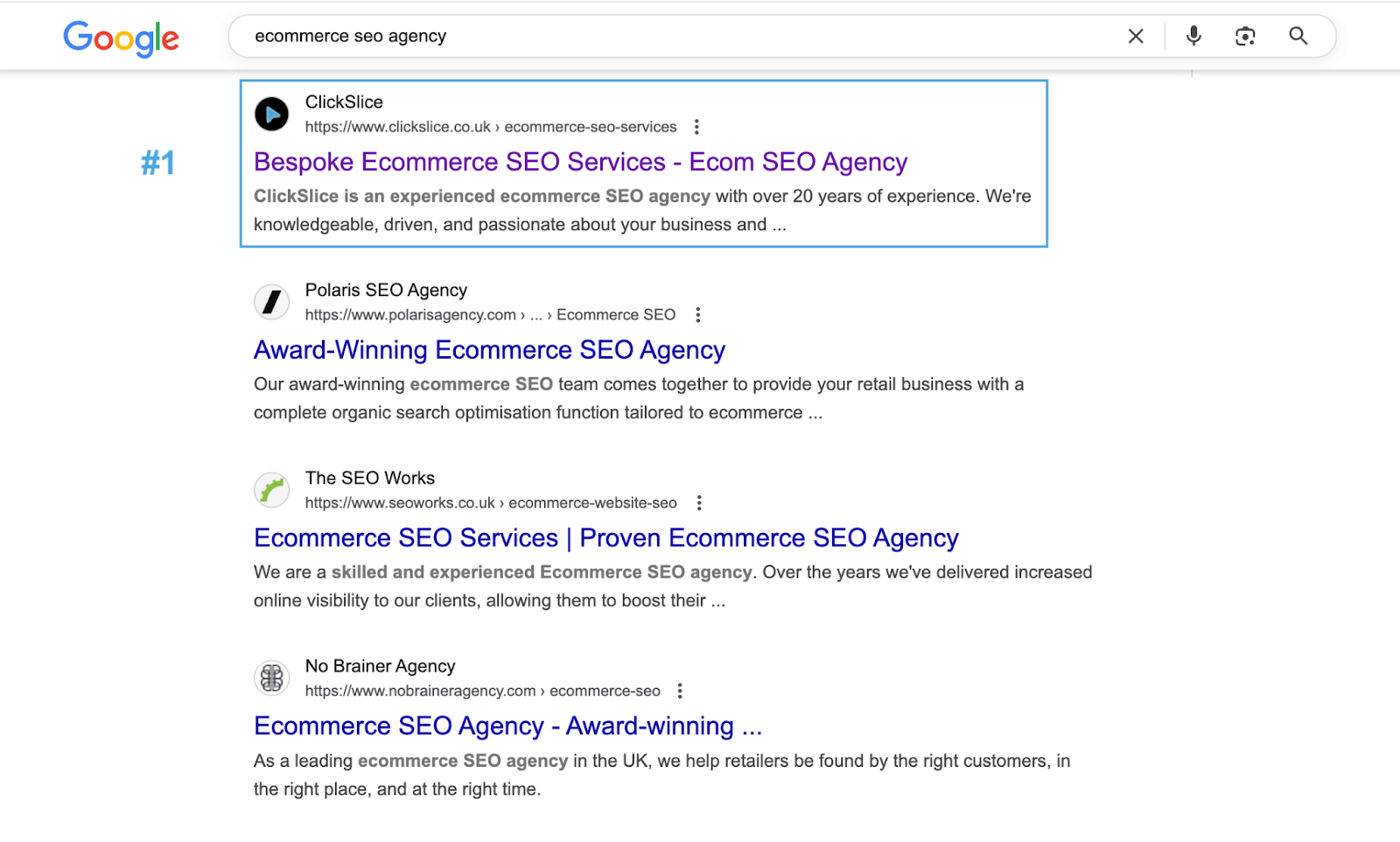
The agency’s key attributes and services include:
- Blended SEO, GEO, and PPC campaigns. Expert integration of organic search, AI-driven discovery, and paid ads for immediate and sustainable traffic growth.
- Search engine optimization. Technical SEO, keyword research, link building, and content alignment to increase visibility.
- Paid media management. Google Ads, Shopping, and social ads aim to convert visitors into customers.
- Landing page and CRO improvements. Website design and page updates turn more traffic into leads and purchases.
- Flexible engagement. Rolling monthly contracts with transparent reporting and dashboards.
- Digital PR and link-building. Outreach and media strategies that support long‑term search authority.
Why should you work with ClickSlice?
E-commerce brands can stay ahead of evolving search with ClickSlice’s tried-and-tested growth playbooks.
By keeping strategies transparent and flexible, e-commerce teams can easily track performance and scale results across channels.
4. GRM Digital: best for complex brand technical marketing
GRM Digital is a Leeds-based agency that helps complex organizations design and deliver advanced digital experiences.
Their technical expertise and data-driven digital strategies suit large, multi-team companies looking to modernize their marketing.
As GRM Digital is technology agnostic, they can work with any software in your stack:
The agency’s main attributes and services include:
- Agile delivery. Flexible project management that adapts to evolving business needs.
- CRO tactics. Updating and improving digital experiences to increase leads, sign-ups, or purchases.
- Data, analytics, and GEO. Making informed decisions using metrics and AI-powered optimization tools.
- Digital and marketing automation. Streamlining processes across websites, portals, and apps.
- Mobile and web development. Building websites, web apps, and mobile apps for complex workflows.
- Strategic client services and discovery. Understanding goals, audiences, and technical requirements for large-scale campaigns.
Why should you work with GRM Digital?
GRM Digital’s in-depth technical expertise is perfect for companies with complex systems, multiple teams, or advanced digital needs.
Contact the team if you need to modernize your customer journey, improve your site or app, or coordinate large-scale strategy and execution.
5. M+C Saatchi: large-scale brand and advertising campaigns
M+C Saatchi is a full-service digital marketing agency for enterprises that want high-impact, culturally relevant ads.
With headquarters in London, their expertise lies in creative, multi-channel campaigns that build desire and deliver measurable brand growth.
For example, M+C Saatchi’s proprietary “Cultural Power Index” uses AI to analyze billions of data signals.
By understanding a brand's true cultural impact, the team uses the insights to shape ad projects:

M+C Saatchi’s key attributes and services include:
- Creative advertising campaigns. Content production, including digital, social, video, and traditional media ads, that engage and convert.
- Strategic planning and creative consultancy. Aligning ad creative with business goals, audience insights, and cultural trends.
- Global campaign management. Vast experience executing campaigns across multiple markets and regions.
- Performance tracking and analytics. Ongoing measurement of reach, engagement, ROI, and campaign impact.
- Specialist services. The agency also handles experiential marketing, events, talent management, sponsorships, and partnerships.
Why should you work with M&C Saatchi?
Companies that want to launch large-scale advertising campaigns and tap into cultural influence can benefit from M&C Saatchi’s creative and global expertise.
Consider this agency to reach the right audience across channels, shape brand conversations, and track performance to maximize impact and ROI.
6. Brainlabs: best for TikTok and influencer-led Gen Z campaigns
Brainlabs is a global digital agency that acquired Fanbytes, an influencer and TikTok specialist that now operates as its influencer marketing arm.
The team helps companies reach and engage Gen Z audiences through creator‑led campaigns and data‑driven insights.
Proprietary data platform Bytesights analyzes millions of influencer profiles to spot trends, track competitor activity, and connect brands with hyper-relevant creators.
Here’s a little bit more about how it works:
Key attributes of Brainlabs’ influencer services include:
- TikTok and social influencer campaigns. Creative content that resonates with younger audiences like Gen Z.
- Relevant partnerships. Working with targeted creators to amplify brand messages authentically.
- Cross‑platform social strategy. Tailored campaigns for TikTok, Instagram, Snapchat, and YouTube.
- Paid and organic social execution. Combining influencer content with paid amplification for broader reach.
- Trend and audience insight. Using real‑time data and trend analysis to guide campaign decisions.
- Performance reporting. Tracking reach, engagement, and impact across campaigns.
Why should you work with Brainlabs?
Brands targeting younger demographics or looking to strengthen social presence will benefit from Brainlabs’ data‑driven approach.
Supported by Bytesights, the mix of influencer and strategic content helps brands connect deeply with Gen Z while measuring impact across platforms.
7. Rise at Seven: best for B2C digital PR and content
Rise at Seven is a UK-based agency best known for creating category leaders through attention-grabbing content and digital PR.
They help brands earn coverage, backlinks, and visibility by creating stories that journalists actually want to publish.
Rise at Seven even offers a targeted US digital PR service, with a team of local experts and solid relationships with American media outlets:

Some of the agency’s most popular attributes and services include:
- Digital PR campaigns. Pushing out newsworthy stories in the UK and US that earn media attention and backlinks.
- Content amplification. Expanding your content’s reach (beyond your site) through press, social media platforms, and search.
- Onsite SEO. Updating websites so they’re indexable and crawlable to improve rankings.
- Creative ideation. Thinking of bold, timely campaigns built around data, trends, and culture.
- Media relationships. Building strong connections with journalists and publishers at home and across the pond.
- Performance tracking. Measuring links, coverage, traffic, and search impact.
Why should you work with Rise at Seven?
UK-based companies that already invest in SEO content but struggle to reach their audience use Rise at Seven to amplify their work.
They’re a strong fit if your goal is to earn attention and build authority through coverage rather than publishing more and more assets.
8. Kitch: best for community-driven lifestyle and food content
Kitch is a UK-based social media agency that helps lifestyle, food, drink, and hospitality brands grow engaged communities through paid campaigns.
The female-led team handles everything from strategy to audience engagement and collecting creative user-generated content (UGC) that resonates.
With a founder who grew up in a family business with 17 restaurants, Kitch pairs real hospitality experience with social-first strategies that drive engagement and revenue:
Some of the agency’s key services include:
- Strategy and planning. Building content plans that align with brand goals and audience behavior on platforms like TikTok, Instagram, Pinterest, and X.
- Social media content creation. Creative content writing, visuals, and platform-native storytelling tailored to each audience.
- Community management. Active engagement and moderation to nurture followers and spark real conversations.
- Paid social advertising. Targeted campaigns on Meta, TikTok, and wherever else your audience is to boost reach and drive traffic.
- Influencer marketing support. Identifying and managing creators that align with each brand’s voice and goals.
- Performance reporting. Tracking engagement, growth, and campaign impact to inform next steps.
Why should you work with Kitch?
Kitch markets itself specifically to lifestyle and hospitality brands that want to build strong communities and measurable engagement.
With years of experience across social media marketing, the creative agency manages all aspects to increase your company’s visibility on key platforms.
9. Croud Luxe: best for luxury brand digital marketing
Croud is a global agency (headquartered in London) that helps luxury and premium brands grow through content, digital marketing, and performance media.
Since acquiring VERB Brands, it specializes in reaching high-value audiences while protecting brand image and positioning.
Here’s the showreel for the “Croud Luxe” division of the agency:
Croud Luxe’s key content marketing services include:
- Luxury content creation and copywriting. High-end editorial, visuals, and video content built for premium brands.
- SEO and search visibility. Organic growth strategies tailored to competitive keywords.
- Paid media and performance marketing. Content marketing campaigns designed to reach affluent audiences and drive demand.
- Digital strategy. Aligning content, channels, and messaging with elevated brand positioning.
- E-commerce and conversion support. Turning interest into sales without eroding value.
Why should you work with Croud?
Premier brands expanding into the UK or Europe can draw on Croud’s deep understanding of luxury marketing.
With offices in New York and Dubai, the award-winning agency has the global resources to help you maintain exclusivity, consistency, and long-term value across channels.
How do I choose the right UK content marketing agency?
The right content marketing agency depends on your industry, how much support you need, and whether you’re working across borders.
Use this quick checklist to narrow your options:
Choose an agency that deeply understands your niche, generates tangible results, and scales with your marketing goals.
Review case studies and testimonials and ask detailed questions during discovery calls about pricing and any additional services.
Prioritize fit over fame, and you’ll end up with a partner who succeeds in growing your business.
FAQs
Are UK content marketing agencies a good fit for US companies?
Absolutely. Many UK content marketing agencies (like Grizzle) work with US companies.
With a mix of in-house and global freelance employees, they’re often perfectly suited to brands expanding internationally or competing in crowded search markets.
What makes a UK content marketing agency different from a US agency?
UK agencies often emphasize editorial quality and more accurate advertising claims (due to stricter regulations).
Many also bring years of experience with international SEO strategy and digital PR, while staying updated on evolving AI-driven content discovery.
Which UK content marketing agency is best for B2B SaaS brands?
Grizzle is one of the best UK agencies for B2B SaaS and tech companies.
The team learns fast to understand your target audience, produce thought leadership-style content, build scalable frameworks, and track the results.
Grizzle drives traffic, demand, and revenue across organic search engines and AI-powered discovery for clients.
Should I choose a full-service agency or a specialist one?
Choose a full-service agency if you want integrated services like branding, web design, content marketing, paid ads, and SEO in one place.
Need deep expertise in B2B SaaS, e-commerce SEO, or luxury brands? Reach out to a specialist (who can still provide end-to-end service).
How do I evaluate a UK content marketing agency to pick the right one?
Look for marketing companies with clear specialization, relevant case studies, measurable results, and experience working with international teams (if applicable).
Say you need help with content marketing strategy or email marketing. Reach out and ask if that’s something the agency offers.
Strong agencies can clearly explain how their work drives business outcomes.
%20-%20Banner.png)
However, true localization means matching how people actually speak, search, and make buying decisions in each region. These nuances help your content feel more natural and trustworthy.
In this guide, you’ll learn six steps to build a content localization model to speed up UK and EU market expansion.
Step 1. Research local customers to reveal pain points
Collect regional customer insights to ensure you create assets that truly matter to those audiences.
For example, a localized guide on domestic ACH payments (which are limited to the US) won’t be relevant in Denmark or England.
So, you’ll waste time repurposing content that isn’t relevant to this audience.
On the other hand, Voice of Customer (VoC) research in these target regions reveals real-world pain points that you can then build content around.
Here are some typical places to find this data:
- Customer interviews. Arrange conversations or surveys to understand your audience’s challenges, goals, language, and buying triggers.
- Employee insights. Ask your sales, support, and success teams what buyers query, where they get stuck, and what they care about.
- Support and sales data. Analyze sales calls, tickets, and emails for recurring issues and themes.
- Social listening. Search your brand on LinkedIn, X, Reddit, and other forums to see how people discuss the problems you solve.
- Review platforms. G2, Capterra, and Clutch are goldmines for seeing what users love, hate, and expect.
Sites like G2 are now even using localization themselves to make it easier for European buyers to evaluate software vendors:
Note: If you don’t have enough first-party regional data, search for public competitor insights. How buyers talk about similar products can still reveal relevant priorities and unmet needs.
The more local insight you collect, the easier it becomes to see the full buyer journey and exact language prospects use.
These nuances help you create content that feels native and builds trust faster.
When Grizzle localized Tipalti’s US-based financial guides for the UK and EU, we conducted in-depth research to align updates with local laws, regulations, and audience priorities.
For example, this OCR processing guide speaks to local priorities with research that highlights the cost of late payments to the UK economy.

And the benefits of this research go beyond marketing:
- Product teams get clearer direction for regional features
- Customer service can better prepare for objections
- Sales aligns more closely with how buyers think
A strong localization engine becomes a competitive advantage across the entire business.
Want help turning your UK or EU research into a clear content strategy? Book a demo today and let’s talk.
Step 2. Prioritize revenue-driving content to reach new markets
Use your localized customer research to prioritize key articles, landing pages, and other assets that solve regional problems and drive revenue.
Forrester suggests that 75% of B2B buyers want sales materials in their language, while 67% want the whole website.
Start with assets that help buyers:
- Find your product or service. Product, comparison, and other landing pages that attract potential customers.
- Learn how it works. Blog posts and guides addressing real problems from your research.
- See it in action. Case studies and product walkthroughs that demonstrate value.
Validate your priorities and identify additional opportunities using data to gauge potential impact.
Internal performance data and SEO tools can help confirm where real demand exists.
Ask yourself:
- Which of these pages already attracts sales from your target countries?
- Which English keyword terms have strong search volume and moderate cost-per-click (CPC) in the UK and Europe? (These metrics demonstrate the likely value of regional traffic.)
- Which topics suggest clear interest in multiple target markets?
For example, some English content can perform well in EU markets with high English-speaking populations (e.g. the Netherlands or Nordics), offering quick wins before fully localizing.
Other topics like “open banking” show strong demand across the US, UK, the Netherlands, and Sweden:
These topics are often safe bets to localize early as they’re already resonating.
From there, you’ll expand into fully localized versions for regions where native language content matters (e.g. Germany, France, Italy, or Spain).
But keep in mind that some terms don’t exist locally.
For instance, “sales enablement” isn’t common in France or Germany, so you’ll need to explain it for your audience to understand.
This approach lets you build a solid content foundation quickly, start engaging new buyers, and gather insights for original, region-specific content later.
Step 3. Build out a regional content team
A team with local expertise is essential for creating content that resonates and avoiding missteps that confuse or even offend audiences.
For example, first names or casual phrases are widely accepted by Americans.
But German differentiates between “you” with “du” (informal) and “Sie” (formal)—the latter is generally preferred unless speaking to kids or loved ones.
Gartner research also suggests that while German consumers value familiarity (think local testimonials and case studies), French buyers favor market leaders (i.e. top-rated positioning).
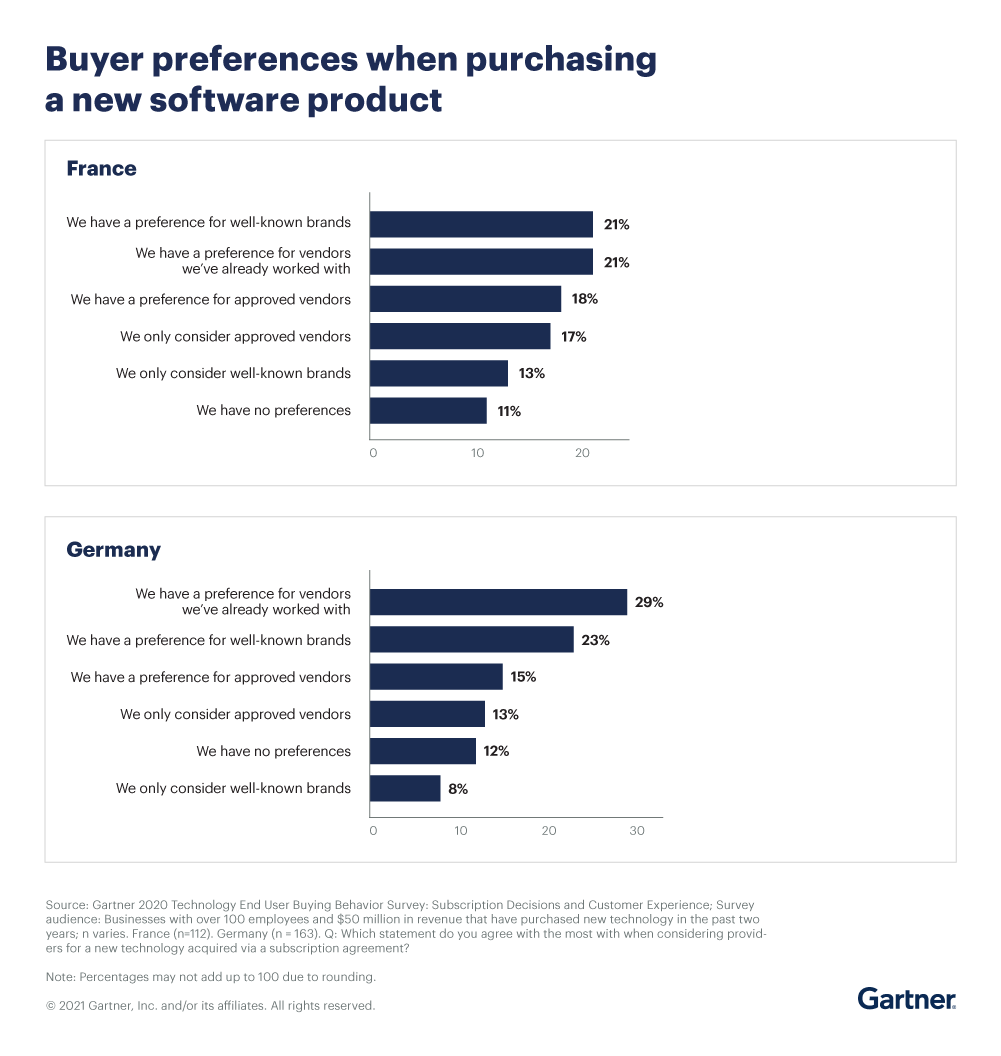
Translation tools often overlook these small details, but they can significantly impact engagement.
A high-performing regional team needs:
- Native-level fluency, including awareness of local trends, culture, and idioms
- Specific industry knowledge
- Transcreation skills (i.e. adapting tone and meaning, not just translating)
However, not every team member needs all of these skills.
For example, a localization manager can focus on strategy and technical SEO, while writers and editors bring native fluency and tone expertise.
Here’s the suggested breakdown of roles and responsibilities:
If in-house resources are limited, agencies or freelancers can fill the gap. Agencies like Grizzle provide scalable, all-in-one solutions—ideal for targeting multiple EU markets at once.
The key is finding the right expertise that fits your goals and budget.
Prioritize local knowledge, bilingual skills, and cultural fluency over cost savings (where feasible).
Your content’s effectiveness depends on it.
Step 4. Involve local subject matter experts to ensure accuracy
Local subject matter experts (SMEs) add credibility, verify facts, and make your content culturally relevant—especially in regulated industries or markets with unique rules.
You need to build trust with regional audiences. SMEs help you earn it by showing authority.
For example, Wise’s guide on UK pension withdrawal includes expert input as minimum age and tax treatment differ from countries like Ireland and Canada:
These experts fill knowledge gaps that even skilled bilingual writers can’t fully cover, ensuring accurate content for local regulations, workflows, and customs.
Your in-house experts (like product managers or compliance officers) can serve as SMEs, depending on the topic.
However, building a network of external SMEs with real-world experience expands your reach and helps you cover topics your team can’t.
Here’s where to find them:
- Audience research tools. Use platforms like BuzzSumo or SparkToro to find thought leaders your audience follows.
- LinkedIn. Search for authoritative figures by title, industry, or experience.
- Help A Reporter Out (HARO) or Qwoted. Submit queries to connect with verified experts.
- Clarity.fm. Connect with specialists in niche industries.
- Professional associations. Reach out to certified experts in your field.
- Industry conferences. Scan speaker lists for those with specific expertise.
- Competitor content. Identify authors or podcast hosts demonstrating niche authority.
Note: For co-created content, collaborating with SMEs who also have an online presence can amplify reach and help you achieve early traction.
When quoting SMEs in your content (instead of hiring them to fact-check), make sure you:
- Double-check names and roles
- Include a link to their website or resources
- Let them review content before publishing
A strong SME network can even open doors to other recommended experts, so your content is always backed by credible, specialized knowledge.
Step 5. Create localized guidelines to scale without losing quality
Create localization guidelines to maintain consistency in your content’s voice, quality, and cultural fit as your business grows.
Don’t be part of the 27% of tech CEOs who didn’t create dedicated resources for regionalized marketing campaigns and wish they had.
For example, Wise’s “Foundations” document aligns every writer, designer, and marketer on the brand’s online presence.
The “Go global, write local” section explains how to write content while staying mindful of diverse cultures:
It flags things like avoiding literal wordplay, staying culturally sensitive, and remembering that translated text often expands by 30% or more (when considering UI design).
This ensures Wise’s content resonates locally while scaling production faster.
A comprehensive localization guide should include:
- Positioning, tone, and personality specifics for each region
- Grammar rules, style choices, and regional conventions (e.g. UK vs US spelling)
- Glossaries with approved translations for product and technical terms
- Design rules and example content
- Tools, workflows, and quality assurance (QA) checklists
Keep the guidelines accessible and update them as the market evolves.
A living document makes it easier for teams to produce high-quality localized content without costly revisions.
Step 6. Optimize content for local search and market entry
Localize content, headings, keywords, and URLs to match each market’s search intent.
Optimizing on-page SEO (often by creating regional versions of your website) supports your GTM strategy by driving visibility and awareness.
For example, Pipedrive localizes 2.7 million words in 24 languages annually.
Like this Italian version of the homepage:
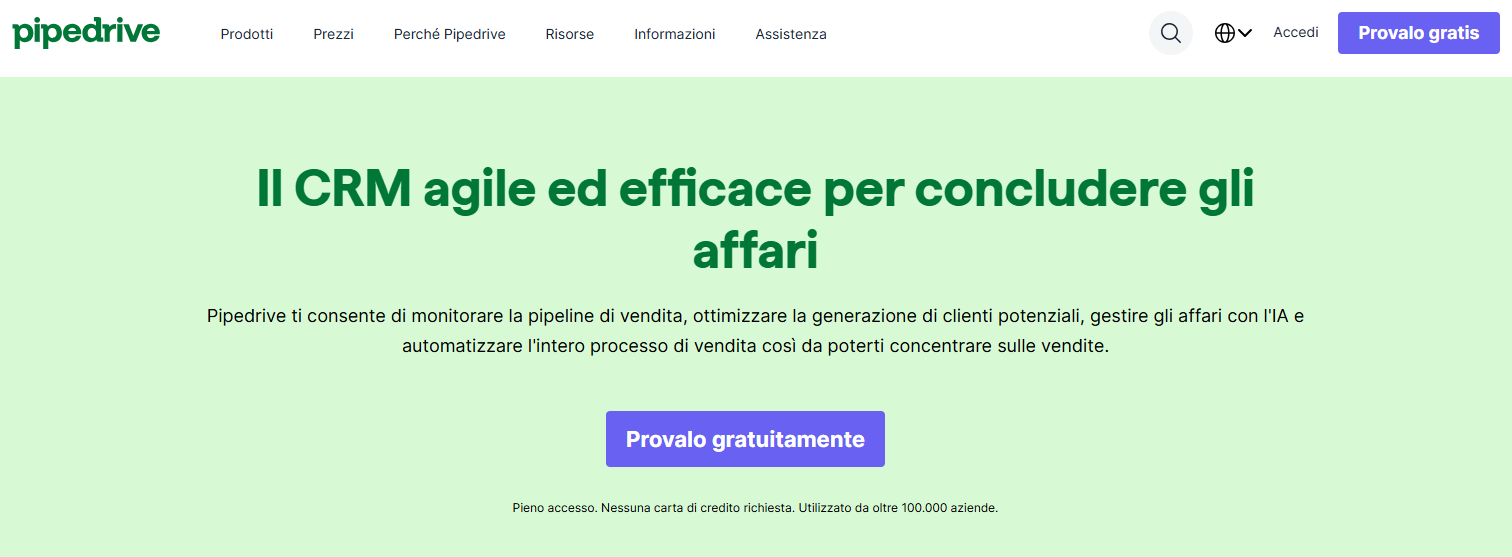
When nearly 66% of software buyers prefer providers’ websites and landing pages in their primary language, you see why localization is critical for complex products.
For more moderate expansion (where you’re testing a market or scaling gradually), focus on optimizing key pages that drive awareness.
For example, Tipalti’s UK PayPal guide localizes the most important on-page SEO elements (URLs, headings, keywords, and body copy):
By meeting intent and improving search visibility, the finance solution now ranks on the first SERP for “How PayPal transfers work in the UK”.
Committing to a full country launch?
Localize all customer-facing content—from marketing pages to help docs—to support SEO and sales.
This strategy works best with local teams (e.g. sales, support, or product experts) to respond to demand and keep channels consistent.
It takes more time and resources, but helps you capture search intent and drive conversions faster.
AI tools can speed up translation for guides, tutorials, and help pages.
But always have bilingual editors review content nuances before publishing.
Localized content drives trust and growth
Anyone can translate text in seconds thanks to AI, but localizing your message to each market’s language, culture, and expectations gives you a competitive edge.
Start with the pages that matter most, test, and refine based on performance data. Base your UK or EU content on local insights and customer needs at every step.
Over time, you’ll build trust, strengthen your presence, and drive sales.
Ready to get your content moving in new markets? Book a demo today and let’s talk.
Get started with Grizzle.